
Episode 018
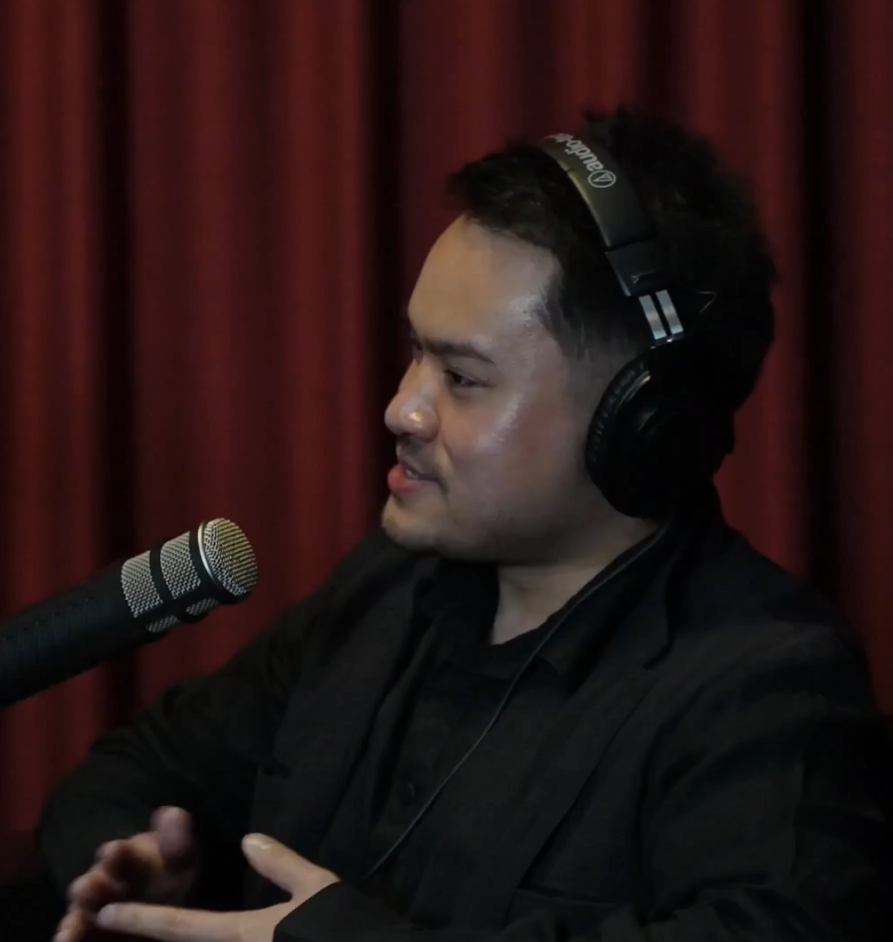
Grimoire Parfums: A Conversation with Trung Vu
Trent and Robyn speak with Trung Vu of Grimoire Parfums about the independent Melbourne house and the stories behind its fragrances.
The masterclass follows Nephilim, Volume I - Mesopotamia. Trung discusses its development, its place in the collection and the connection between mythology and perfume.
The conversation explores creative choices, materials and the time involved in building the brand and its collection.
Smell this episode
Nephilim by Grimoire Parfums, available at Olfactive Melbourne Perfumery.
About the guest
Trung Vu is the perfumer behind Grimoire Parfums, an independent house based in Melbourne.
In this episode he introduces Nephilim and describes how fantasy, fiction, religion and mythology inform his work.
From the episode
Editorial prompts introduce unedited excerpts from the automated capture. Speaker turns and transcription accuracy are unconfirmed.
What ideas shape Grimoire Parfums?
So yeah, I like to say Grimoire Parfums is just a manifestation of all the things I love which is fantasy, fiction, religion, mythology, all these ideas, all things macabre and other worldliness. Yeah, it's all about kind of like you said blending classical ideas and kind of structures and techniques, you know, making it artful, so creative, lots of storytelling, that dark and a bit edgy, not necessarily challenging but I'd say highly stylistic. Fantastic. We are looking forward to diving into this. This is an absolutely amazing brand.
Which perfume did you choose for the masterclass?
Now you've actually brought your entire range in with you today. Uh but obviously we we select one particular fragrance to master class and then we'll explore the broader range a little bit later in the show. So which particular fragrance would you like to select for the master class today and why that particular perfume? Yeah, so for today I have selected Nephilim um which is titled number one or volume one from the region of Mesopotamia and I think it probably represents the brand the best in a few different ways.
What makes Nephilim important to you?
Um firstly the story but also in terms of technical technical proficiency and style as well. Um and it's kind of like my little baby. It was a formula that took the longest to complete, probably about four years in the making. Yeah, I like to say it's kind of my personal pièce de résistance um for now. Might might get a few more later but for now it is. I'd say you've got many many ahead of you uh Trung. So we're really keen to to get stuck into it and start smelling straight away.
Read the episode transcript
This transcript was made from the episode audio and checked for names and spellings. Timestamps are approximate, and any offers mentioned were current at the time of recording.
0:00 Trent and Robyn (self-introductions; other turns unconfirmed): Hello and welcome to the Olfactive Melbourne podcast. I'm your host Trent Stokes. And I'm Robyn Stokes. We're a husband and wife team passionate about perfume and we're on a journey to better understand explore the art of perfumery. We're coming to you today from Melbourne, Australia and we'd like to acknowledge the traditional custodians of the land on which we're recording. They are the Wurundjeri and Bunurong people of the Kulin Nation. We pay our respects to their elders past and present and we extend that same respect to all Aboriginal and Torres Strait Islander people who are listening to the recording today.
0:33 Speaker not confirmed: This show we interview Australia's premier niche artisanal and indie perfume brands from the founders to the perfumers and onto the creatives who take us on a guided journey through a fragrance that best represents their brand. The show is wrapped around a master class in which we invite our guests to take us through each stage of the opening, the heart and the base. The show unfolds in real time meaning that there is time in between the opening and the heart and the heart and the base and this is known as the dry down.
1:05 Speaker not confirmed: During the dry down we take the opportunity to deep dive into the perfumer's journey, their brand, their mission, their vision, their values along with getting a better understanding of some of the technical terms in perfumery along with how to identify individual notes and chords so that we can more deeply connect with perfumery and also so that we can better identify the notes that we like and dislike. This allows us to make more informed decisions about the fragrances that we connect with and that we ultimately wear.
1:33 Speaker not confirmed: The show is designed to be both educational and entertaining. So if you like what we do please like and subscribe and make sure to sit back, relax and enjoy the show. The Olfactive Melbourne podcast is proudly sponsored by Watch Vault, Australia's premier destination for luxury and vintage timepieces. Each watch is trusted, verified and ready for its next chapter. Visit watchvault.com.au to discover your next timeless investment. Hello everyone and welcome back to another episode of Olfactive Melbourne podcast. Today we're joined by Trung Vu who is the creative mind behind Grimoire Parfums.
2:04 Speaker not confirmed: Grimoire is an independent Australian brand that blends classical perfumery with storytelling and imagination. Welcome to the show Trung. Yeah, thank you so much for having me. It's great to have you with us. Now just to kick off it would be wonderful if you could tell us when you first launched Grimoire and where you're based. Yeah, so I am based right here down in Melbourne and it actually hasn't been launched for too long. Um it was officially pivoted into the atmosphere October 12th.
2:32 Speaker not confirmed: So yeah, it's very new. It's still in its infancy and there's still a lot things to do and a lot um things to learn as well. Congratulations on the launch. Now if you could tell us a little bit about the identity of Grimoire Parfums and what it means to you that'd be great. Thank you. Yeah, so Grimoire Parfums it has been a project that has been in the works over the last five, six years. Um something I always wanted to do intended.
2:59 Speaker not confirmed: You know, at the time I was working in perfumery, didn't know too much about the creation process. So I had my eye set out to learn perfumery and this was always like the objective. Grimoire I always like to say, you know, I've cycled through so many ideas over the years and think about like what should I do as a brand, what will people connect with, you know, all of that. Really at the end of the day you go back to the one you always originally intended because it's always the most personal.
3:30 Speaker not confirmed: So yeah, I like to say Grimoire Parfums is just a manifestation of all the things I love which is fantasy, fiction, religion, mythology, all these ideas, all things macabre and other worldliness. Yeah, it's all about kind of like you said blending classical ideas and kind of structures and techniques, you know, making it artful, so creative, lots of storytelling, that dark and a bit edgy, not necessarily challenging but I'd say highly stylistic. Fantastic. We are looking forward to diving into this. This is an absolutely amazing brand.
3:59 Speaker not confirmed: Now you've actually brought your entire range in with you today. Uh but obviously we we select one particular fragrance to master class and then we'll explore the broader range a little bit later in the show. So which particular fragrance would you like to select for the master class today and why that particular perfume? Yeah, so for today I have selected Nephilim um which is titled number one or volume one from the region of Mesopotamia and I think it probably represents the brand the best in a few different ways.
4:29 Speaker not confirmed: Um firstly the story but also in terms of technical technical proficiency and style as well. Um and it's kind of like my little baby. It was a formula that took the longest to complete, probably about four years in the making. Yeah, I like to say it's kind of my personal pièce de résistance um for now. Might might get a few more later but for now it is. I'd say you've got many many ahead of you uh Trung. So we're really keen to to get stuck into it and start smelling straight away.
5:00 Speaker not confirmed: So I might ask uh Robyn if you can spray us and spray some blotters. So uh just for those people listening um we are currently uh Robyn's currently spraying it out onto a set of blotters and she's also going to spray it onto our skin. We always do this on the show because we like to get a really well-rounded uh sense of the fragrance. Uh when you spray a fragrance onto your skin the way the fragrance reacts to your skin, microbiome in your skin, the heat on your skin, this whole range of different factors that can uh push certain notes forward a little bit faster.
5:35 Speaker not confirmed: Um you can smell something slightly different whereas when we've got the blotter we are all smelling exactly the same thing. Uh it's nice and consistent. Now before we get stuck into actually having a smell and I can already smell it so and I I can't wait for you to go through the description here. Uh this is an educational uh podcast and we like to let our viewers know exactly what we're doing at every stage of the show. So what we're about to do on the show here is we're going to smell some opening notes and when I say opening notes what I'm referring to is our perfume pyramid.
6:11 Speaker not confirmed: So the perfume pyramid is the traditional way in which we construct perfume. If we think about a pyramid uh we have our peak right at the very top and that's where our opening notes sit. Opening notes are made up of the lightest and most volatile of the aroma molecules. That means that they surface to the fragrance first but they also dissipate the fastest making way for the heart notes sitting right in the center of that of that perfume pyramid. Below that we have our base, the wider section and that's where we have our heaviest now densest notes.
6:44 Speaker not confirmed: Now this is the traditional way in which we build a perfume. However, this is not always the way a perfume will unfold but just for the sake of explanation this is how we uh will experience our opening opening notes. So we're going to go through those opening notes now. So with that very long explanation of opening notes Trung what are we experiencing here as we have a smell? Yeah, so in the opening and most of my perfumes if not all of them actually they are built in a traditional perfume pyramid where there is a transition from top to heart into base and intentionally so.
7:19 Speaker not confirmed: I think it's always something fascinating when a perfume gives you progression and different stories and layers as you wear it. Um something I love about classical perfumery as well. What is Nephilim and why have we called the perfume Nephilim? Yeah, so Nephilim is a story that actually appears in the Bible in the very first chapter or book in Genesis and they are described as half beings or half breeds. They are the children of a fallen angel or an and a female woman and the fallen angels are the angels that uh lost in the war or lost in the holy war against God and the idea of Nephilim was to play on this idea of lust and transgression with that kind of unholy matrimony between two different species.
8:01 Speaker not confirmed: It's a taboo of nature. So you know, it's a duality of sensuality but also eroticism at the same time. So it's pulling on kind of different ideas and yeah, that kind of contrast between comfort and lust is what I want to represent in their film. With Nephilim what you're smelling in the very opening is red wine. You've got pink pepper, lemon, angelica and tomato leaf and the funny thing about this fragrance is I have actually not built a red wine accord.
8:29 Speaker not confirmed: There is not a red wine accord that exists in my perfumer's palette or arsenal let's call it. Uh and that's the kind of funny idea about perfume that's not really talked about much. Um it's this idea of suggestion. There is such thing as placebo in perfumery. If I tell you something is in it you are inclined to believe it. And what I've brought in today is actually a plumber chord which is what the original intention was when I was workshopping the fragrance and going through all the series.
8:58 Speaker not confirmed: This one was a long-winded one. It's gone through over 70 different reformulations and probably about like 70 80% the way through. I thought it needed to be more of a fruity character, a bit more greenness to it. So I started to play with a plumber chord that I had created about four years ago. So some of my very early work and yeah, when I inserted it into the perfume what I smelled was actually not really plum and it's kind of the fascinating thing about the other notes having a hand in how things smell and how they blend together.
9:31 Speaker not confirmed: And I've actually brought my plumber chord in today for you guys to experience um and you can kind of see how it sits on its own and how it works in the perfume and I am not a classically trained nose. So when I look at some of my very early work I think I'm a bit crazy. It's definitely not something I would do these days. Uh yeah, it's the beauty of um ignorance let's say it um or intuition rather. So in my early plumber chord
10:00 Speaker not confirmed: There was when I was looking through it again, there was actually 10% cypress, which is insane. That's a bit more of a technical detail, but yeah, insane. Let's actually give it a try, shall we? Yeah, let's give it a try. I've got to say, just while you're grabbing that that plummer chord, we've we've experienced a whole range of different notes in perfumery, and we know that a lot of the time, particular notes are left out of perfume. We don't necessarily list everything.
10:26 Speaker not confirmed: Sometimes things are just supporting notes. Their job is to to sort of fix or push forward other notes. They're there, but they're not significant enough to mention, or we deliberately leave them out. I don't think I've ever experienced a perfume where we've made a suggestion that something's there, but it's actually not. So this is actually quite I don't know about you, Rob, but this is quite unique for me. Yeah, it's totally unique for me too. Yeah. It's something quite interesting. So Yeah, it's it's a funny kind of point of interest, and it's actually a lot more common than you think.
10:57 Speaker not confirmed: Yeah, because perfumery is all about, in a way, suggestion and perception. You tell the audience what they want to believe or what you want them to believe also. Here you go. This is the plummer chord. Thank you. And when I create my chords, I try to get them as hyper-realistic as possible. That's nice. I love that. So a plummer chord is not a super difficult chord. You'll build it around a couple of different green notes, your rose ketones, some of your aldehyde C14.
11:23 Speaker not confirmed: But yeah, the reason I think it actually works as a red wine suggestion, let's say it, is because of that 10% cypress. And again, that's the beauty of intuition. Cypress is a conifer and it's got a lot of kind of terpenes in it, and so does wine. And naturally, it just kind of worked out in my favor. It was a lovely mistake. It's absolutely beautiful. It's it's obviously, you know, we're smelling the the accord there, so it's quite strong. But you smell that and then you smell the perfume and you can smell the scent of it in there.
11:54 Speaker not confirmed: I can completely understand why you've used this to suggest wine. It works with the other notes in combination with those other notes. I am definitely getting that suggestion. But now, because of the psychological it's not quite warfare that you're engaging with me, but that that psychological trickery, I can't tell now whether it's because of the suggestion or because I'm actually smelling it and it's the the combination of notes. That is something quite unique and not something I was aware of in perfumery that was actually something common.
12:21 Speaker not confirmed: Yeah, no, I wasn't either. And I guess it's why some of the perfumers that we've talked to, they always say, we love it when people just smell our fragrances without having any idea what the notes are and tell us what they think they can smell before they go off and look at the notes. So, you know, it's kind of interesting from that perspective as well. Yeah, and it's kind of part of the storytelling. Like the red wine seems so ceremonial to the whole idea, especially like it's a religious kind of idea and it's almost like a covenant.
12:51 Speaker not confirmed: So yeah, it definitely fits in with the theme. And it's actually used a lot more this idea of suggestion in perfumery than we think. Especially a good example is like building fruit accords. Fruit accords probably some of the hardest to do in my opinion from a technical level. And the trouble with fruits is they just don't all fruit molecules, they just don't last long. So what we do is play a bit of trickery. So if we open an accord with like, you know, your classic for this purpose, let's say the plummer chord, to kind of give the illusion of longevity, you would actually use vanillin or vanilla compounds to give it that sweetness into the dry down.
13:27 Speaker not confirmed: But because we have that association with plum in the opening and the sweetness in the dry down, you actually still think it's plum that goes through the top and the heart and into the base as well. So this is just a really good call out for our viewers and listeners here. I think when I recall the experience that Rob Knight and I had when we first walked into our first niche perfumery, the person behind the counter sprayed out a perfume, I can't remember what it was, but they stuck it under our nose and said, what can you smell?
13:58 Speaker not confirmed: And we both looked at each other and went, oh my god, I'm freaking out. I could tell what she was thinking and I was thinking the same thing. What if we say the wrong thing? But the truth is it doesn't matter. What you smell is what it is, right? So because we are working with accords, the accords are the construction of a note to represent the note, not the actual note. Even if you are using the actual note, if you smell something different, it's because it may have combined with something else to produce a different scent.
14:28 Speaker not confirmed: Or you've got the suggestion, you've got the imagery, you've got the archetype that you've built it around, the story, this whole range of things that can affect how you experience it because it's not just it's not just smell, is it? It's a sensory experience. You are smelling with your eyes, with your nose, you're feeling it on your skin. I mean, I can see the glistening on my skin right now from this fragrance. It's a whole experience. Now, there's another note that you have mentioned in the opening here that's I sort of feel like I should know, but I don't know.
15:00 Speaker not confirmed: And that's angelica. What is that? It's pretty much a plant, but the part that we use in perfumery is the root, angelica root. It is a very green note. It's almost kind of transparent, like it's different to galbanum and kind of violet leaf. It has almost like a bitter herbal medicinal touch to it. Not too much, very, very light. And it's one of those classic combinations that works really well with rose, which we'll get into a bit later. Yeah, and that's the whole idea.
15:26 Speaker not confirmed: I think stylistically as well, like I use a lot of classic combinations and a lot of classic references. And, you know, things that just work. Like I'm not reinventing the wheel here, but just doing it in my own way. Interesting. Well, we'll have to come back to the angelica and rose combo, but I wanted to ask about ivy because I noticed that was also in the chocolate. Yes, that is also just another suggestion as well. Again, just seems very ceremonial and pertinent to the story.
15:52 Speaker not confirmed: Not that it has any relation to the Garden of Eden, but you know, it's in the same kind of territory. So you know, you have this kind of like unconscious kind of, you know, it's a bit of subliminal messaging, but yeah, you know, it's just another suggestion. I actually haven't built an ivy accord. I worked with a lot of green notes, but yeah, it's all about audience psychology. I suppose when you think of ivy, and especially when we're talking about an old biblical story, your mind just associates ivy and the story.
16:21 Speaker not confirmed: So creeping plants and Absolutely. So the Nephilim, I just want to circle back to the story for a moment, only because it's been a little while since I've been at school and I've actually studied this stuff. But this wall that you refer to, is that the war, I guess, that sort of sent Lucifer to Yes. Okay, so it's that old tale. And so there was a war that waged, I think, in heaven. My god, I'm really stretching my memory back here, and you can probably correct me here.
16:48 Speaker not confirmed: But was it that Lucifer was jealous of humans? Is that the story and that's why they waged the war? I don't know to be exactly sure. I think it was more like he wanted to overthrow God. So he's going for the power. Correct, yeah. And so obviously he didn't win. They got sent to earth. And so then you had these angels that actually bred with humans and the output of that relationship, so the babies that were born are the Nephilim. And so they're their own sort of breed.
17:16 Speaker not confirmed: They're not an angel, they're not a human. No, they're kind of like these humanoid giants and there's kind of different versions of them depending on which story. Like it appears in the Book of Enoch as well, which is not canon to the Bible. In that take, I believe that the story of Noah's Ark where the great flood occurs was actually to rid the earth of the Nephilim because they were giant and destructive beings. They were known to be chaotic. Wow, okay, very interesting.
17:42 Speaker not confirmed: And so what we're capturing here in our opening notes is that I guess that sensuality of the meeting of the angels and the humans and the creation of these Nephilim beings. It kind of sets the scene and it kind of is a nod to me stylistically as well. I am not a botanical perfumer. I am a modern perfumer, so I use the full spectrum of the perfumer's palette. But stylistically, I do pay a lot of respect to the botanicals or the naturals that go into it.
18:09 Speaker not confirmed: I try not to adulterate them too much and I do the best I can to enhance it and give them the frame they need to shine in the spotlight. So in all of my work, you will find there's a lot of green elements because they're great naturalizers for these materials because the natural extracts themselves don't necessarily smell like how they do in real life. So you know, how do you manipulate it to give you that real-life experience? Absolutely. And a lot of these notes that, you know, that we want to use in perfumery, it's just not possible to use a natural because there's just not a natural.
18:42 Speaker not confirmed: There isn't enough within the flower or whatever it might be to actually use one of the various different extraction techniques that we've learned on the show. And so the only way to do that is to build an accord. And I guess a good example of that is, I know you didn't build a red wine accord, we've used a plum accord, but you couldn't just pour some red wine into a perfume. It doesn't work like that. Same as leather, right? You can't just soak some leather in some liquid and extract the leatherness from it.
19:11 Speaker not confirmed: You've got to build an accord. And this is the way perfume is constructed. Yeah, and that's another great example of suggestion and association because, as we know, leather doesn't really have an inherent smell. The association comes from birch tar. And I think it was the Russians that were first doing it. They were using it to treat their leather and it worked as a great preservative and antiseptic. And it becomes association, suggestion, psychology. It all goes together hand in hand. So what are you getting in the opening here?
19:39 Speaker not confirmed: It's quite green and fresh to me in the opening. That's my first impression. I think I'm getting some of the tomato leaf, but I'm definitely getting some lemon in here as well. There is a lift or a little of something to the smell, but to me it sort of comes at the end. If I have a big sniff, then it's sort of at the end. I get this little
20:00 Speaker not confirmed: brightness and a bit of a pop. And I think there's one key heart note that's starting to come through already here, but um not so much on the blotter on my skin because because of the heat. It's come off my my skin. Fantastic set of opening notes. So we've got ivy, pink pepper, lemon, angelica, and we've got the um tomato leaf as our our opening notes. Where it sets um the story is set around the Nephilim and some absolutely amazing bottles here.
20:25 Speaker not confirmed: So great experience of the opening. What I'd love to do now though is I want to get to know you a little bit better. So take us back. You said that you've been on this journey of creating perfumes for for many, many years now, but where did the interest in perfume actually first start in your life? Yeah, well, I think for a lot of people you kind of fall into it. It's not something I intended um to happen. It just kind of like I guess was a natural progression.
20:53 Speaker not confirmed: So originally I started out like finished high school, was in uni, but actually dropped out to pursue a dancing career because I was I trained from a young age as a dancer and you know that's what I wanted to do at the time. So I left uni, joined a company, trained full-time. And then you know a few years later I fell in love with makeups and you know the world of makeup was booming, social media was booming, and I kind of fell into it as well.
21:19 Speaker not confirmed: Um so I went to school for that, became a makeup artist. Worked as a makeup artist for a bit, ended up at Armani. I was a makeup artist for Armani and naturally there were fragrances there and that kind of kind of I guess set my love for perfumery because there was the range that I had never experienced before called the Armani Privé. You know there was a lot more than just a smell. You know we all know Acqua di Giò, but you know I've never had never experienced the Privé and there was like artistry and sentiment and storytelling and quality.
21:50 Speaker not confirmed: It was a different caliber. The thing about working retail is that you know they only teach you how to sell. They just tell you what's in it. There's bergamot, there's birch, there's violet and rose. What is bergamot? I don't know what that is. So you know I always had this kind of never-ending determination to learn more, you know know the ins and out of actually what bergamot is rather than simply being told that it exists in the perfume. So that's kind of where the journey began.
22:17 Speaker not confirmed: And then like a lot of people COVID happened and you know you're contemplating what you want to do, what you want to achieve. So yeah, that's when I had set myself on that journey to having my own brand one day. Like that was the objective. During COVID I had started learning perfumery, that buying books, reading them as much as I could. I probably spent about a year before I actually delved into raw materials. And that was just to I think for me theory is important um and I know that as a dancer and as a makeup artist, you know they're very classical art forms and there's a lot of technique involved.
22:51 Speaker not confirmed: So I wanted to pay respect to perfumery as well because I know it is a highly technical art form. And until this day I still feel kind of feel like it's actually more of a science than it is an art. So it's it's yeah, it's really interesting. Really diverse background that you've got there. So gone from being a dancer to being a makeup artist and then that makeup artist journey has taken you into a you know a world-renowned brand that just so happens to sell perfume.
23:18 Speaker not confirmed: And you've only been given a very superficial look at the the range and that sparked some curiosity around wanting to know a little bit more and that set you on that journey. And I mean I think there's like obviously there's a connection because all of your previous careers you have had amazing creativity in all of those. So that's obviously an innate part of who you are. But what made you decide to create your own fragrances rather than just be sort of like create the brand?
23:44 Speaker not confirmed: Yeah, um well I think it comes down to artistic ego. You know I wanted to represent myself, who I am, who I as a as an artist, my identity. And for me it was never just about creating a brand and putting my name on it. I wanted it to be deeply connected to it. And this is more of a personal kind of like pressure I put on myself. I think that there is something really special when it comes from yourself or the heart.
24:09 Speaker not confirmed: And in the same way that you know when a singer sings their own song instead of having someone else write it for you or when a chef brings you the food to the table instead of the waiter, like there's something magical that happens there that you can't explain. It's a kind of there's nothing lost in translation. And you know there are beautiful things that come from partnerships, from collaboration, but for me this is always something that I wanted for myself. It's quite the commitment to make.
24:36 Speaker not confirmed: I I would say that 90% of the people in your position that got really passionate about perfume and started to I guess understand the ingredients would poss would very likely go and find a perfumer who would then create the your your vision on on your behalf. But you've gone that extra step to actually learn the art of perfumery, sort of teach yourself. How did you actually go through the process of teaching yourself perfumery? Um a lot of intuition unfortunately. Perfume information, there is a lot out there, but it is very hard to find.
25:05 Speaker not confirmed: You you can scour the internet for days and not find any answers. But at the same time there are a lot of answers as well. And yeah, it's a very technical art form. And I don't think I've been necessarily necessarily influenced as a dancer or a makeup artist, but I think it's actually given me the aptitude I need to kind of pursue this kind of journey. Like it's I can see why a lot of people kind of like stop halfway through because there's capped to it.
25:31 Speaker not confirmed: That's how much you can learn. So I guess I mean you mentioned there that there's there's a lot of information out there. And so you didn't you know pack yourself up and go okay I'm going to go and do a four-year degree in France. You just went about finding that information yourself. I guess was that you searched the internet, you bought books, you know is that was is that basically what the process was for you just It's a process of experimentation.
25:56 Speaker not confirmed: Yeah, it's a lot of trial and error. Um when I got my hands on my materials, you know you don't know what you're doing. You just kind of kind of got to figure it out. But then you know I did receive a bit of mentorship, you know um connecting with people and different independent perfumers around the world online and giving me kind of little tips and tricks. They don't give everything away so you are left to your own devices a bit.
26:22 Speaker not confirmed: Um but a lot of my learning is also just from being a collector and a lover of perfume myself. I have quite a big collection. And where I love perfumery the most is kind of the great classics, vintage perfumery. So a lot of things from the '20s through to the '80s. And even when you smell things now that I'm a bit more experienced, you can kind of see the structure, the technique, and how to dissect the fragrance a little bit better.
26:47 Speaker not confirmed: So you know it's like these reference pieces. As you know any kind of case study as an artist you would do, you kind of reference older paintings, like what made it great, what techniques have they employed. So it's the same kind of concept there. So you've got a bit of a classical perfumery vibe about your perfumes and it's inspired by that love of those sort of older older perfumes. Yeah, and I was I kind of like to say that even though I'm not classically trained, I think I am on my way there as self-taught as I am.
27:17 Speaker not confirmed: Um yeah, and I think that probably comes back to ballet or yeah, classical and contemporary ballet. It's all about it's a very regimented art form. So I've always had great respect for technique and kind of learning the fundamentals and the foundations. Well, given that you are so fresh at having set you know a business up like learned the art, built your perfumes and and launched a business, I'm very keen to understand that process. But just before you do, just because you've mentioned classical perfume, give us a few of your favorites.
27:45 Speaker not confirmed: What are some of those classics that you absolutely love? What I wear, what a perfumer wears, um yeah, all those granny fragrances that you can think of. They're all on my top shelf. So Knowing from Estée Lauder, Bal à Versailles, I love Guerlain's Aromatics Elixir, all of them. Some real classics there. Yeah, Knowing from Estée Lauder is one of the very early perfumes that I bought as well, which I've been thinking recently I should get it in a bottle for sentimental purposes.
28:10 Speaker not confirmed: You sort of wonder these days though like if you buy that now is it going to smell and was it constructed in the same way. We'll probably touch on IFRA a little bit later in the show, but um I mean I've smelled some pretty classic fragrances as well. We've obviously got a very old bottle of Chanel No. 5 that dates from from the '60s. The ingredients that are in that bottle are likely in that bottle today due to some of those regulations.
28:35 Speaker not confirmed: Fantastic. All right, all of us you know perfume geeks are loving all of that. But um while we're on the on the track of that process, take us through what does it take to start a perfume business. Yeah, so I am still in my infancy so there's a lot of learning still left to do and you know um yeah, it's strange. So last year, as you guys know, I've been working the retail fragrance space for a while now. Last year was about 18 months ago I'd say was the time I thought I was I won't say ready, but you know 80% ready because you know you're never fully ready.
29:09 Speaker not confirmed: You just have to take the leap of faith at some point. Um so that's when I felt like all right it's time to give it my all, put my time and effort full-time into creating this world of perfumery and Grasse. And there's a few reasons it kind of took so long. One was capital, like takes a lot of money, especially if you want to do any form of customization as I've learned. Um the amount you have to order is kind of insane.
29:34 Speaker not confirmed: Is that the customization of the bottles? The bottles, the labels, the boxes, the ribbon, the blotters, the bag. So there's always a minimum purchasing order um for customization, which is you know it's a kind of how do you call it, like a hurdle for a lot of brands or kind of brand owners out there getting started. Like it does take a lot of capital. And yeah, I'm kind of glad I was very frugal over the last five, six years and I had the
30:00 Speaker not confirmed: contingency to save extra, um just in case I needed to spend more because I actually probably end up spending about almost three times more than what I anticipated. What I anticipated to spend was not necessarily educational, it was just like a random ballpark number. But yeah, you know, you're into deep, you got You can't You can't look at it anymore. You're committed. You've already You've jumped out of the plane already. You're already on the way down. But on the other hand, you've been able to, you know, launch with um amazing unique bottle and as you say, all the components of the box and and everything which from what we've from some of the other perfumers that we've spoken to, they've had to migrate to something more customized over time because they haven't, you know, they've started in a different way.
30:43 Speaker not confirmed: Absolutely. I think I mean we've sprayed out Nephilim, but what we didn't do was actually show off these amazing boxes that you've got. So what I might do is I might um grab one just to show the camera quickly. And for those people listening, we'll make sure that we post a link so that you can see this. Because they are absolutely stunning, no doubt about that. Yeah, so the everything is about a grimoire. For those that don't know, a grimoire comes from old French.
31:09 Speaker not confirmed: It is pretty much a magical book. It is usually a book of dark magic, so it kind of relates to um witchcraft, incantations, spell summonings, sometimes demonology as well. So everything about the brand is a motif of the book. I always kind of beat myself up for staying as long as I did in retail because I knew I wanted to do more. I knew I had the potential to do more. But in a way, it's kind of there's a silver lining there and a blessing in disguise because um it's kind of taught me a lot of things, taught me about branding and how important identity is and what the selling points are.
31:44 Speaker not confirmed: As much as perfume is about what's inside, like there is a very visual aspect to it as well. So I always knew that's what I wanted to achieve and put out into the world. Yeah, I I agree. Perfume is it's quite visual and I mean perfume is not cheap. I mean there's cheap perfume out there, but you get what you pay for, right? So if you were going to buy anything that's half decent, you're going to be spending a couple hundred dollars.
32:09 Speaker not confirmed: If you're spending a couple hundred dollars on a perfume, you want the whole experience to be something special from the box to the bottle. The cap has to be nice. The spray itself has to be beautiful. Every little touch needs to be something a bit special. And I always feel a bit um hard done by when I buy a a niche perfume or an expensive perfume and it lacks that. It's like there's no care that's been put into everything else because we consume it with our eyes before it ever goes onto our skin.
32:38 Speaker not confirmed: I think it's really important. I've got to say, I mean it's grimoire, the story's there. The box for the perfume is is the book. It's just absolutely brilliant. There's not a single bit of detail that's been left off there. And no wonder it took you quite some time to do. Yeah, it took it took a bit of time. And then, you know, that's the art of luxury as well that I've kind of developed that skill over time. As much as we don't like the word luxury these days, but you know, it's all about the details.
33:08 Speaker not confirmed: It's the kind of small gestures that you don't really notice, but they are there and they kind of um tie the whole package together. Yeah. So did you do the designs? I did actually. Yeah, the funny thing is, uh this is a bit of advice for anyone starting out. Uh yeah, I did do the designs. I didn't know what I had planned to do with it. I had a general kind of faint idea, but it was a lot of improvisation. I wanted to save money where I could, so I just ended up doing everything myself.
33:37 Speaker not confirmed: And when you go to a manufacturer, they don't really collaborate with you at that level that you think they might. Their first question is, all right, how many units and where's give me the design? So I was like kind of, you know, kind of not starstruck, not the right word, but you know, I was in shock in a way because I didn't know what I was expecting. You know, there's no one to hold your hand when you do these things. So yeah, I just I was actually playing with AI for a little bit trying to see if they could create a lid for me and nothing was just working.
34:11 Speaker not confirmed: It wasn't practical. So I just I took my sketchbook out, just started drawing things, sent it off to the manufacturer and they're like, actually we need a technical sketch. We need all the measurements, all the angles. Oh wow, okay. So I did that. They come back to me, okay, we actually need it in vector format. I don't know how to do that. We need a 3D rendering now, next step. So that the 3D rendering was the only thing I outsourced because I would have had no idea.
34:38 Speaker not confirmed: Fair enough. But yeah, it's just a lot of things I've learned along the way as I've done it. A lot of other kind of business and compliance things as well. Yes. Yeah, yeah. Wow, so you've learned the art of perfumery, you've learned how to draw and design and then move into the Adobe Creative Suite so that you can actually provide all of the technical drawings and you've done everything from scratch. Now I've done I've done a little bit of um, you know, packaging in the corporate world before and I certainly know what you've encountered there.
35:07 Speaker not confirmed: They don't help you at all. If you give them something that's not quite right, they'll manufacture something that's not quite right for you. They do exactly what you've asked them to do unless they actually can't do it and that's when they'll get a little bit of clarity from you. So probably a really good lesson there for anybody who is, you know, wanting to set out. You've got to think of everything here from the packaging right through to the juice itself. So yeah, it's quite a quite a complex process.
35:35 Speaker not confirmed: Now you mentioned there that custom means quite a lot of quantity as well. You're probably going to need space to be able to store the quantities of packaging and bottles and all that sort of stuff as well. Yeah, my garage is full to the brim at the moment. For my caps, I had to order 3,000 units to begin with, which is actually quite a generous deal. Industry standard is actually 10,000 units. You know, it's still a lot and it's a big startup cost, but you know, there's there's no way around it.
36:03 Speaker not confirmed: This is what you have to not necessarily sacrifice, but this is what you have to pay. Yeah, yeah, it's all in. Absolutely. I think you're going to move through that pretty quickly to be honest. So absolutely, absolutely because it is it's beautiful. And we're going to explore the the broader range a little bit later in the show and people get to understand exactly why I've just made that that comment. But before we do that, I think we actually should explore the heart notes.
36:29 Speaker not confirmed: This edition of Olfactive Melbourne is proudly brought to you by Silver Australia. Silver Australia design and shape their jewelry in their studio in Melbourne and they're pleased to offer Olfactive Melbourne listeners 20% off when you use the code MASA20. So we'll just go back to the perfume pyramid for a moment and describe the heart notes. So the heart notes form the center of the perfume pyramid and generally they start to surface once the top notes begin to fade and they can feature things like florals, spices or sometimes aromatic herbs that define the character.
36:58 Speaker not confirmed: And this is where the heart of the perfume really comes into its own. Its whole character really blossoms. It will be the bridging to create a smooth transition between the bright top notes and the richness of the base notes. And it lingers and leaves a beautiful memory. So with that being said, please take us through the heart notes. Yes, so in the heart notes, it is all about the floral and what the core of the fragrance is. So it is Bulgarian rose and there's actually three types of Bulgarian rose in there.
37:26 Speaker not confirmed: There is French rose as well. And then it's kind of a medley of different florals um to kind of help transition the top into the heart and some help to transition the heart into the base. So we've got lavender, geranium, other flower and a bit of kind of odd material here called as well. Well, look, I mean we have to start with the rose because it's very to me it's quite prominent on my skin. So tell us why you chose to put three different types of Bulgarian roses and the French rose.
37:55 Speaker not confirmed: What does the French rose bring? Yes, so French rose or centifolia rose is usually a lot more jammy, so I wanted to use that to bring an element of sweetness to the fragrance. But the Bulgarian rose, I think is much more sensual, which is what I wanted to use for Nephilim as the kind of main component to represent this idea of sensuality, which was the rose. The Bulgarian rose, the species is Damascus rose or rose damascena. It has a lot more kind of powdery spice nuances to it.
38:22 Speaker not confirmed: It's a lot more deep and kind of more sensorial as well compared to the French rose. Again, this choice to use three different roses was kind of to help it um give a bit more space in the perfume, you know, helping it to kind of project into the opening, have that body or that space or that presence in the heart, but also carry through into the base as well. And usually you can't do that with one material or natural alone. You need to kind of play with different materials and different aroma chemicals and compounds as well.
38:52 Speaker not confirmed: A very classic rose structure or rose molecules that you need in the opening would be rose oxide because it's very volatile, it's very bright in the opening. And for the base, you need like rose crystals to give it that longevity. But they're more the supporting notes. And I am using rose oil, which is actually probably one of the crown jewels in my palette or repertoire, which I brought for you guys here to smell. We're very lucky. I've got to say, you know, you mentioned before that, you know, the the rose punches through that that opening.
39:22 Speaker not confirmed: I did sort of allude to that to start with because you can when you first spray this on, you do get the rose coming through sort of straight away. Not as prominent as it is now. Now it's really blossoming, I would say. But I think you did a really good description there before that the heart note really sort of bridges both the opening and the base there. And I think this rose is a really good demonstration of that. Yeah, and this is like the magic of the fragrance that I love about it.
39:50 Speaker not confirmed: Like it's just the way the rose oil blooms in the heart and there's nothing like it. It's so magical. And as good as we can build our accord, nothing compares to the
40:00 Speaker not confirmed: There is just a level of magic and chaos that you can't get when you build in a code and you know it's all that volatility in the natural or the imperfections of it as well that come through. Rose oil, this is by LMR which is kind of like a fraction of IFF. Okay. They are probably the Rolls-Royce for materials. So it is very pricey but that's also reflected in my products as well or the price of the products. But yeah, it's just so creamy, so decadent and has kind of these like strawberry tones to it as well.
40:32 Speaker not confirmed: So one of the things that we probably haven't done a lot on this show is is have a discussion about where a lot of these materials are sourced from. So you mentioned IFF as being the Rolls-Royce. What are some of the other places that you can I guess get these type of raw materials from? Yeah, so there's like a four or five main manufacturers. We've probably heard of them. So Firmenich, Givaudan, Symrise, they're kind of the main manufacturers for kind of aroma chemicals.
40:59 Speaker not confirmed: And then for like your naturals, just put that down. For your naturals, there's kind of like a big five. So LMR, which is a fraction of IFF, is kind of gold standard and they are great for sustainability. They work direct with the farmers and it's fair wage, ethical, traceable. And some of the other ones, Robertet, old company, I think they've been around probably since the 1800s. That long. Do correct me if I'm wrong. Mane, Payan Bertrand, you've also got Floral Concepts.
41:26 Speaker not confirmed: So there's lots of these great kind of manufacturers of naturals and they all have great kind of ecological footprints as well and they're always renewing their technologies to be as green as possible. So I think it is important where you source your materials from. Yeah. And it, you know, it shows in the fragrance. You can't kind of hide that fact. But also as a perfumer, especially after doing all this compliance work on myself, I think it's very important to get it from reputable places because they have all their documentation ready.
41:56 Speaker not confirmed: They have their SDSs, they have their IFRA certificates. They've done their GCMs on their materials. Tells you exactly what allergens are in it. Especially when you're doing your own paperwork. You know, Australia doesn't really have like a GCMs service that I know of. If anyone out there does, please send them my way because it will save me a lot of work. Yeah, that stuff is kind of important, especially for like compliance is one thing, but also for health and safety as well.
42:23 Speaker not confirmed: I mean, at the end of the day, people are putting this on their skin. Correct. And you're putting your name on this perfume. And so you definitely want to be playing it safe. And I'm sure there's quite a lot of complexity around making sure that you're compliant. It makes it hell of a lot easier if you're going to a really reputable store, a source to start with. One thing I just don't want to gloss over here is you've just passed us over a beautiful raw ingredient.
42:51 Speaker not confirmed: And what I would encourage our listeners and our viewers to do is do this yourself. Get hold of some of these raw ingredients. You might not be able to get something at this level that Trung has brought in, but something quite magical happens when you smell the raw ingredient and then you smell the perfume. You can actually start to pick out the individual notes. It makes it a lot easier. I think this is sort of like training your nose to be able to identify notes.
43:19 Speaker not confirmed: Otherwise, because it's so beautifully blended, it's hard to pick out the individual pieces of it. But as soon as you handed that to me, I had a smell. I passed it back to Rob and had a smell. Now I can identify it. So if you're interested in educating yourself on perfume, this is probably a good place to start is pick out those raw materials, start training your nose so that you can identify those individual notes. Yeah, and who doesn't love to smell natural rose, right?
43:47 Speaker not confirmed: Because it's such a high vibration. Yeah, the thing is it doesn't smell like real life roses. It has a very different profile. And rose oil is one of those, it's a very rare case where the rose oil is actually a lot more expensive than the absolute. Usually it's the other way around and it has to do with like how much it yields from the starting weight of your raw material to how much oil it produces. So it's a very rare case.
44:14 Speaker not confirmed: So rose oil is probably about three times more expensive than the absolute. So it is crazy. That's just the volume of roses they need to use just to get enough oil out of it. So it's a high effort, isn't it, to extract rose oil? So you also mentioned as we were going through those notes, a very strange sounding ingredient. Is it choya choya loban? Yeah, choya loban. What is that? It is kind of only an ingredient you see in artisanal work and independent brands.
44:42 Speaker not confirmed: You kind of see it every now and then from a lot of independent brands. Very peculiar material. Not something you see in commercial perfumery just because it's not produced at that volume. Like it's not scalable in a sense. But it is pretty much frankincense turned into a tar. So choya is an ancient distillation technique that falls under the category of destructive distillation. Destructive distillation, you've experienced some destructive distillation before. There's not very many. There's probably only four or five that I know of.
45:09 Speaker not confirmed: It is the process of when material is put is kind of heated at high temperature in a vacuum with no oxygen. And what happens is when the kind of aromatic essence kind of starts to seep out, it gets burnt and it transforms into something completely new. So two examples that you probably know of destructive distillation is a birch tar. So it's usually your tars. So birch tar is one and also cade oil as well. Yeah, the problem with a lot of, not a lot, well, those two examples are they actually produce a lot of carcinogens as well called PHAs.
45:42 Speaker not confirmed: Okay. Polycyclic aromatic hydrocarbons. So when you use those materials, you have to buy rectified versions where they have those compounds removed. And even then it's still restricted to near nothing. But you don't need that much. It's such a powerful material. So choya is a similar kind of method. It's the same kind of burning of the material, but it's done in earthenware. And the other choya is choya nakh, which I use in one of my fragrances as well. And that is burning of crushed seashells.
46:10 Speaker not confirmed: And it's a co-distillate of sandalwood as well. So it's actually burnt together. So interesting. So can I just make sure I understood that? It starts off as a resin of some sort and then it becomes an ash. Is that like or a smoke or something else through this process? So it's kind of like you extract the essence out of it. So the kind of raw essence comes out of the raw material. And then under that high heat, it transforms into like that tar.
46:37 Speaker not confirmed: And yeah, you kind of just dispose of the solids after it. Okay, yeah, very interesting. Just when we thought we couldn't learn about any more techniques, here comes another one. It seems like it's endless the number of different techniques in perfumery. I have no idea how you navigated your way through as a self-taught perfumer with just the volume of different distillation techniques that you can use, the different notes that you use, how to even combine those notes. No wonder the journey took so long.
47:05 Speaker not confirmed: Yeah. Yeah, it's quite a complex process, although so very interesting. You can't stop learning perfumery. Like there is no cap. Yeah, absolutely. 100% agree. That's what we love about this show, right? Because we get to learn about it all from the masters, which is amazing. Absolutely. Now you've got a, not only do you have beautiful bottles and you have really beautiful boxes, but you've also got a really beautiful website. And I jumped onto your website and I did a little bit of research before you came on.
47:33 Speaker not confirmed: And I've got a quote here from you, which is, I'm not here to reinvent perfume. I simply want to make perfume that smells good. And so I think this is a good little segue into I guess your approach and your philosophy to perfume. And I think you did touch on it a little bit in the opening. I guess what is, how would you describe your approach and your philosophy to the construction of perfume? Yeah, so that does sound a bit more dramatic than what it actually is intended to be.
48:03 Speaker not confirmed: You know, you've got to be a bit dramatic for the website. Yeah, I think in the world of perfumery today, it's not like it was as we call it the golden era of perfume. Perfume is a bit more of a kind of a commentary on the world of perfume at the moment. At a commercial level, it's definitely not the same. It's a bigger monopoly than it ever was. And you know, brands are getting picked up left, right and center from bigger kind of entities and you know, they kind of have to play it safe.
48:34 Speaker not confirmed: So you know, artistry is kind of taking a bit of a backseat and it's more about the numbers, how much they're selling. And you know, for me, I just kind of want to bring the artistry back into it. Yeah, so it's not about reinventing perfume. I just want it to smell nice. That's dumbfounded as that sounds. I don't think that's the case at all. I mean, it's the right approach, right? Perfume's about smelling nice. You don't necessarily have to make something that is super challenging and difficult to wear just for the sake of it to demonstrate your artistic prowess because you could put it on and go, wow, that's, I don't want to wear that.
49:12 Speaker not confirmed: Like it's unique, but I don't want to actually put it on. So far, I have smelled all of your perfumes before. There's nothing there that is challenging, overly challenging. That doesn't mean it's not complex. But you know, nothing smells unpleasant. We've smelled a number of unpleasant perfumes, haven't we? We've gone, we really want to like this, but we can't because it just doesn't smell nice. But then there's also, you know, a lot of people will comment, I like the smell, but I don't want to smell like that, right?
49:41 Speaker not confirmed: So it could be a gourmand or something along those lines where it smells yummy or you want to eat it, but you might not want to necessarily wear it all day to the office. Absolutely. Now you've touched on a really important point here that you are an independent perfumer. You're a niche perfumer, I guess an artisanal perfumer.
50:00 Speaker not confirmed: the industry is dominated by big brands, not many of them. So, while we might walk into Myer or David Jones and you've worked in retail and we see brand after brand after brand after brand, they're actually all of those brands are actually owned by like three or four companies. So, it's companies like Estée Lauder, LVMH Group. These companies own hundreds of those brands. And so, while you might see Tom Ford or you might see a Chanel, they're all just sitting under one banner being made by one company.
50:28 Speaker not confirmed: Yeah, they're all made by different perfumers, but once you fall under this big corporate banner, you can only operate under pretty strict regime. One of that one of those rules, I guess, or that regime is that it has to be very profitable. And so, what are you sacrificing when when you need to make things profitable? Correct. Uh, the story. Yeah. Yeah, there's also like a trend that I think is really unfortunate at the moment where not so much in the niche houses, but you know, sometimes the perfumers aren't even credited anymore, which I think is such a shame.
51:00 Speaker not confirmed: Yeah, it's a Yeah, it seems to be the realm of niche perfumery where you'll actually credit a perfumer with that particular perfume, but once it falls under one of these major houses, you wouldn't know who makes that that And it wasn't always like that. Like they always used to credit the perfumers. It's only been in like I've noticed in like the maybe the last five years where And you can sort of see how those perfumers have rebelled a little bit against this as well by going out and starting their own brands or working with some of those niche houses so that they can be credited.
51:33 Speaker not confirmed: And I've got to say, um, I guess when I was growing up with perfume, you know, in the '80s, I didn't really know who the perfumers were. These days, we know who the perfumers are. They're rock stars these days. And it's kind of interesting that you mentioned that. Like I haven't thought about it, but yeah, when you Alberto Morillas has his own brand now, Dominique Ropion has his own brand. What's your view on the Australian perfumery market? Australian perfume, I think there is a lot of potential and space for Australian perfume to grow.
52:03 Speaker not confirmed: There's a lot of great artisan perfumers out there. You know, it's just very hard and starting my own business, I can understand why. Like it takes a lot of capital to get it out there. And Australia is just in that kind of unfortunate spot where it's so far from everything and, you know, shipping is a big kind of cost and import tax and duties as well. But there is a lot of potential, I think. Yeah, I think I would like to see a bit more kind of modern perfumery come out from Australia.
52:33 Speaker not confirmed: I think because we're very grounded as a culture, so there's a lot of natural and botanical perfumery here. I would love to see a bit more kind of like modern, not necessarily experimental, but you know, the full range of the perfumer's palette. A little bit less safe in terms of pushing the edges a little bit more. So, Yeah. More identity. Yeah, a bit more identity. I think identity is huge in perfume. Yeah, I think so. I think so. The more I am into perfumery, the more I appreciate, you know, that a strong identity means quite it means a lot.
53:05 Speaker not confirmed: Yeah, absolutely. I mean, if there's a lot of perfumes out there and if you don't stand for something, I mean, you just got to drown amongst everything else. And I think this is what you've done very, very well here is that you've brought a very strong sense of identity and a very strong sense of story. And every single one of the fragrances has not only the identity of Grimoire and that idea of those dark tales, but they've got their own individual story which is quite detailed.
53:32 Speaker not confirmed: What it provides is a connection with the consumer, right? Which I think, you know, what makes you stand out when you're seeing all these amazing, all these products and you're smelling a whole heap of things, you know, if you have a connection or you've heard the story or you've, you know, got some connection to it, I think it makes a big difference. Yeah, I think it's very important. What's not funny, but you know, what was also important for me as well was like as glamorous as the story was, I wanted it to, you know, be objectively good as well.
54:04 Speaker not confirmed: So, remove all the story, you don't know anything about it, I want it to still be an experience. And that was like my kind of, um, I guess my kind of threshold or benchmark. Yeah, makes sense. Sort of feeds back into the statement about you just want to smell good because at the end of the day, I mean, if it doesn't smell good, you can tell as many stories as you want about the perfume and it still doesn't smell good and people don't want to wear it.
54:32 Speaker not confirmed: Ultimately, it's about smelling good and having a beautiful experience. And this is I think the thing that we're really attracted to with perfume is that perfume's beautiful. It's just a beautiful thing. And who doesn't want to be experiencing more beautiful in their life? And it's ultimately it's got to smell good. So, I mean, I've been sitting here now looking at these fragrances for a while. I'm so keen to jump in. So, we've got five total in the range here. Obviously, we're doing the masterclass around Nephilim, but which one do you want to get stuck into first as we explore the broader range?
55:04 Speaker not confirmed: We might as well go in order. Each fragrance is numbered. They're numbered volume one through to five, which is a bit not back into the concept of the book. And on the back of the book, you've got the region and also the name of the fragrance. So, fragrance number two is from the Balkan region. It is I should preface though, so my debut collection is called Ex Fabularum and it means of the stories in Latin. So, each fragrance tells a different story or a different folklore from a region.
55:33 Speaker not confirmed: And what I wanted to do with each fragrance is capture the emotional of the story, but also pay respect to the culture that it comes from. So, a lot of the materials will come from there as well or a lot of the references are from the culture. So, this one is of Slavic mythology. It's called Todorac. It is a fragrance that kind of represents destruction because the story is destruction. It's very powerful and unapologetic. It is the powerhouse of my collection.
55:59 Speaker not confirmed: You can't miss it. As soon as you spray it, it's Absolutely. And yeah, the story goes during the wintertime in Eastern Europe on the eve of Saint Theodore's Day, these kind of giant creatures appear and they're a hybrid of a human and a horse. Not so much like a centaur, though human torso actually grows out of the horse's back. And they're usually veiled and clothed, their face is veiled and they have long robes. And what they do is they just kind of ravage and stampede the villagers.
56:26 Speaker not confirmed: So, it's a story of destruction. And the only way to kind of stop them is the village people have to bake a cookie in the shape of a hoof and feed it to the horse. So, there's a bit of a whimsical element in there. This is an intriguing smelling fragrance. Obviously, when we get to this section of the show, we can't go all the way through through the dry down. So, can you just take us through the opening, the heart and the base notes?
56:53 Speaker not confirmed: Obviously, we can only smell the opening notes here, maybe a little bit of the heart coming through, but what are all of our notes here? Yes, I'll go through the actual chords or the kind of idea or concept first. So, this is kind of a tribute to Serbia, which is where a lot of my chosen family is from. So, it's everything. It's a bit cliché in a way, but it is the smell of different European or Balkan liquors. So, one is called Pelinkovac, which is a bitter herbal liquor made from artemisia.
57:23 Speaker not confirmed: Another liquor is Slivovitz, which is plum rakija. It's kind of like the equivalent of a brandy. And you've also got quince brandy as well, which is Dunjevaca. And the base is beeswax, which is a nod to the Orthodox church because they only use beeswax candles. And then there's just a hint of cigarettes as well because, you know, it wouldn't be Eastern Europe without it. And yeah, and there is a kind of overlying chocolaty brioche note, which is a nod to the cookie in the story.
57:50 Speaker not confirmed: So, I try that where there is where I can, I'll try to give a nod to the story. Wow. So, the notes you're actually smelling, I won't go through all of them, but just the main kind of notes. In the opening, it's artemisia, you got celery, you got star anise. In the heart, it is immortelle, which I actually do have immortelle here for you guys to try. It's a very interesting material. No, me neither. So, it's not really used. It's not uncommon, but it's not featured much.
58:18 Speaker not confirmed: It is the key ingredient of my fragrance, which is also why the fragrance is so dark, as you guys can see. All of my fragrances are uncolored, so that's the actual natural absolutes and the oils coloring them. Immortelle absolute, there's very few examples of where it is actually featured in a fragrance. I do know Annick Goutal did one called Sables and there's one called Vol de Nuit from Histoires de Parfums, which I really love. It's a great fragrance. But yeah, let's give it a try, shall we?
58:45 Speaker not confirmed: Absolutely. Yeah. Yeah, it's extremely dark. This is boozy, isn't it? I mean, that's what I get. It's boozy, but you know, when you said celery, I was like, oh. You can, you can definitely smell the beeswax. Yeah, first impression I got was definitely that boozy, boozy smell. And now that you've given us the story around it, it absolutely makes sense. All right, so this is Immortelle Absolute. All right, so this is my very first experience of this. I'm looking forward to this.
59:12 Speaker not confirmed: Yeah, it's a very peculiar note. It's quite multifaceted. It's got elements. So, it has a very distinct maple kind of odor to it, comparable to fenugreek. And sometimes it's actually called the curry plant. It's also known as everlasting flower. So, it's got a fenugreek element to it, that maple tone. It's also quite ambery and lavender-esque as well. And it's quite it's a very dry material. The absolute is very different to the essential oil. It has like this very gingery aspect. It's not really used in perfumery, it's more in aromatherapy.
59:40 Speaker not confirmed: But yeah, very beautiful kind of magical material. That's a good way to describe it as rich. That is not what I had in my mind whatsoever. And again, same experience that I had before smelling the raw ingredient. Once I've smelt it and then I'm putting the blotter to my nose, now I'm starting to detect it. And here's another one, another main
60:00 Speaker not confirmed: kind of ingredient I brought for you guys to experience. This is Beeswax Absolute from Robertet. The immortelle was from Maine and contrary to what we think, it's actually not that sweet. It has more of a salty It's not too animalic, but there is a kind of trace of it, but it's almost like a umami kind of quality to it. Yeah, it's very complex. I really like I like the Yeah, I mean before you just described it there, I was expecting the honey type of smell, but yeah, you're right.
60:27 Speaker not confirmed: It's not it's actually not all that sweet. No, there's hints, but not it's not honey sweet at all. So in the actual fragrance, I've sweetened the kind of honey accord and I have built a honey accord for the fragrance. Wow, is that interesting? Let me smell the blotter again. Okay, I can see what you mean. Already, even on the blotter, because we know that the blotter it takes a bit of time for the the dry down to occur. This is evolving actually quite quickly on on the blotter as well.
60:55 Speaker not confirmed: Yeah. Yeah. Yeah, I was thinking that every time I have a smell, it's Yeah, I mean it could be the interplay between the the raw ingredients and what I'm smelling now as well, which is probably playing around with my mind a little bit. Yeah. Yeah. But um yeah, I'd say this is quite a complex quite a complex fragrance. So it's quite interesting texturally as well. This is the one I've probably played with texture. So it's a very dry There's a lot of kind of drier array of notes in there.
61:22 Speaker not confirmed: The immortelle is one of them, but also the hay and the tobacco. Then it also has this very syrupy kind of gourmand quality, but not enough to call it a gourmand. It's kind of it's a bit of a grey area of like what what you would categorize it. It's like it's herbal, it's boozy, it's sweet, but it doesn't really fit into anything. Yeah. It's very gorgeous. Okay, so when you say um when you play you're playing with texture, you mean, you know, the dry, the sweet, the interplay of these different sort of elements is is texture.
61:52 Speaker not confirmed: Yeah, really interesting. This beautiful fragrance and I can see I mean the story the story matches the um the fragrance. And I guess this is probably a good good time to ask you. I guess where do you start? Do do you start with the story or do you start with the fragrance or is it like is it a combination you make a fragrance and then you go, oh, that story will fit or I mean what's the what's the process there for you?
62:17 Speaker not confirmed: So there's no way away around it. I generally start with the story first. I actually choose the name and before I choose the kind of fragrance notes and the the notes will kind of be built around that. And I have this little thing I do. It's silly, but it's very quirky. Um I will kind of build a diagram of how I want the fragrance to look in Canva. I like to call it my poor man's so I just kind of copy a lot of the images and put it into the Canva database.
62:45 Speaker not confirmed: And I'll kind of kind of play around, you know, what do I want to feature, what it'll look like because it kind of gives you a visual idea of what a fragrance would smell like. So yeah, I kind of build it like that. Yeah. That's cool. Okay, and that gives you the the the mental image of it and then you go through the process of actually playing around with those individual ingredients and tweaking and and balancing it out so you get your get your fragrance.
63:12 Speaker not confirmed: Intriguing. I love this. Yeah, and the the concept always changes over time, but I think we're always very ambitious when you start out. You have so many different ideas and very a lot of different accords you want to do. Yeah, as you work out the fragrance, so the the not the problem, but one of the kind of hurdles of perfumery is like you would never know what it smells like until you finish blending. So you don't know if it's going to work or not.
63:37 Speaker not confirmed: Yeah, usually most of the time you'll find that it doesn't work. Edit things, take things out. I probably end up with probably a third to a half of the accords I originally created for the fragrance just because they don't they don't mesh together. I think this is a learned skill in a way as an artist, the the ability to edit and kind of, you know, taste level. Yeah. Yeah. So just keep playing around with it until you make it work. So you might get 90% of the way there and then you'll add that final accord or that final note and it just doesn't work.
64:09 Speaker not confirmed: And so you you might remove something or you might keep that in and delete something else to make the whole thing work. And yeah, when I I think I've finished the fragrance, not not that everything is ever finished. I think there's a famous saying around painting where it goes along the lines of, you know, painting is never finished, it's just merely abandoned. So it's kind of the same kind of concept for me. I stop working on the fragrance when I think there's nothing left to take out.
64:36 Speaker not confirmed: Okay. So typically, and I think you might have mentioned it at the top of the show, but so forgive me if you have already answered this question, but typically how many iterations does it take you before you you're happy or is there just not a typical? Not necessarily a typical. The first one did take me the longest. That was about 70 iterations. 70. 70. Yeah, wow. Okay. And the other ones, I want to say they're about aside from number four, which took me about 12 or 13 iterations, that one I finished surprisingly quick.
65:05 Speaker not confirmed: The others were about 20. Okay. So it it's a bit of a a labor of of love. Definitely a labor of love, yeah. Yeah, absolutely. Fantastic. Oh, that is absolutely lovely. I love love that fragrance. I love a good boozy fragrance. All right, let's move on to chapter three, sorry, volume three. I should say volume three. Um and this is going to just while um Robyn's spraying this one out, this will remain the naming convention in the the volume. So we'll go from obviously we we get to volume five today, but when you release your next fragrance, it'll be volume six and so on and so forth with no end, I guess, at least for now.
65:40 Speaker not confirmed: Okay, so we're at volume three. What's this one called? For now. Uh this one is called and it is a story from the Scandinavian region. Comes in a few different names or it's known as a few different names, the creature. Sometimes called known as Nix or Nixie as well, just depending on which country um the story originates from. But yeah, uh this particular name is from Norway, but you do see it in Denmark, Finland, bit of Germany and Amsterdam as well, which is a bit lower.
66:06 Speaker not confirmed: But uh the it is a water spirit. It is a creature that lives in different bodies of waters in Scandinavia. They're a shape-shifting creature. One of its kind of most prominent forms is in the guise of a beautiful male with long hair and that plays the violin. And they play it so beautifully that it lures whoever's listening into the water where the actually drowns them. Yeah, it's not a happy ending. So a little bit like a siren. Yes. Yeah, okay. It's I've got to say um you know, if you have discovered this this podcast and you're coming back to it, I'd say hit pause, grab the grab the experience pack, the sample pack, and come back and smell along with us.
66:43 Speaker not confirmed: And something amazing happens when you tell the story. The fragrance evolves as you're telling the story. It's just it's amazing sort of mental interplay between the notes and the actual story that you're telling. As you described this water spirit, I was getting more and more of those watery type of notes coming through before before you've even discussed a single note that's coming through here. I think you need to experience the fragrance along with the story. I think it's such an important part of the identity of but just as you tell the story, it's quite amazing what's happening at least in my mind.
67:15 Speaker not confirmed: Yeah, definitely perfectly connects. The story and the fragrance connect very well to me. Yeah, and that was my intention to kind of, you know, the abstraction of smell into a story is kind of where the art lies as much as as it is a technical art form. That's kind of the outside of it. And so with this fragrance, I wanted to play on this. It's kind of different stylistically to the other four. It's probably the least perfumey, I'd say, and it plays more on the idea of hyperrealism.
67:41 Speaker not confirmed: And what I mean by that, I wanted it to smell as true to life as possible. So it's all about imagery this one. And the image I'm trying to capture is the lakeside forest in all of its glory, the good, the bad, and the ugly. So what you I wanted you to smell is the trees, the wild flowers, the berries, the mists, the kind of cold air, the water, the algae, the fungi, bit of that rain as well. So that's the kind of image I wanted to capture.
68:08 Speaker not confirmed: It definitely evokes the sense of being in the outdoors and as you say, because we're hearing the story of water, you connect it with that, but it is more than that. You can now that you've said described all that imagery of nature, yeah, it's captured. You get all of that um that story of someone making their way through the forest towards the water like they're being called. It's getting that that misty forest, mossy. Yeah, and it's kind of meant to feel a bit dangerous as well like when you're alone in the forest.
68:37 Speaker not confirmed: Um I love Nordic noir, so it's kind of like an ode to that, you know, the kind of danger of solitude in a way. As peaceful as the forest is, um that's kind of the kind of emotion I want to capture. And what you're actually smelling in the fragrance, it's a lot of green notes, it's a lot of berry notes, and a lot of conifers as well. So in the opening, you've got blackcurrant, which I brought for you guys to smell.
69:02 Speaker not confirmed: Blackcurrant is one of those really interesting naturals. There's very few natural fruity smells. Blackcurrant is one of them, osmanthus, davana, another few, but there's very rare to have anything that is naturally fruity. What a treat to be able to actually smell these raw ingredients as we go along as well because it does it really does help identify um the notes in perfumery. And so as I mentioned before, if you're the type of person who does struggle to distinguish individual notes when you smell a perfume, what an ideal way to actually train your nose to smell.
69:31 Speaker not confirmed: So what we're smelling here is sorry, you said it was blackcurrant. Yes. Blackcurrant absolute. Sometimes you'll see it called cassis, which is just the French uh way of saying it. It's a very peculiar material. You know, when you hear blackcurrant, you think it's going to be something sweet and kind of syrupy, but it's I wouldn't say it's too far from that, but it has very kind of interesting aspects and a little bit off-putting as well. Um so it is actually quite sulphuric in nature and it is likened to the smell of cat piss sometimes.
70:00 Speaker not confirmed: I'm sorry, it doesn't have urine qualities to it, but it do have that kind of sweet kind of iodine-like quality from the blackcurrant. This is not a foreign concept to us on this show. Like, I haven't smelt anything Thank you. I see what you mean. Yeah, it's kind of nice and it's also got that element of, as you say, cat piss. Yeah, but somehow it works. Yeah, I mean, we've not indole before, which is the the the I guess the poo type of of smell.
70:28 Speaker not confirmed: Very interesting. I love indole. I I work a lot with indole. Okay, yeah. Yep. Wow. Okay, that's yeah, that's a good description, isn't it? That's challenging smell, but it's not it's not unpleasant. It's not like an it's not like an animalic. Smell it again. Yeah, I know. It's like the first the very first smell it's is challenging for sure, but then as you smell it again and you smell it again, it's it's a little bit addictive. It's wow, how unique. Yeah.
70:54 Speaker not confirmed: Cuz I I think I was sort of thinking before you told us about this during that it was going to be a bit like a ribena kind of smell, but it's not. No, no, no. It's not at all. Yeah. Yeah. Well, that's really interesting. Yeah, and that's one of our jobs as a perfumer is to take these naturals and give them the support and the background they need to smell pleasant cuz sometimes they don't smell that way in their raw state.
71:21 Speaker not confirmed: But it also gives you like a greater appreciation for perfumes that are using natural background where you pick up those kind of off notes and like you know they're using the real stuff. Absolutely. Man, when you think about the raw ingredients of a lot of things, they they don't say taste very nice. If you were to take all of the raw ingredients of beer, it's doesn't taste like beer, does it? Right? So, um yeah, you've got to combine them using that sort of alchemy of of being a a perfumer before you actually get that nice taste and it's the same with the the smell of perfume.
71:55 Speaker not confirmed: So, yeah, quite unique. But that is that it's definitely a challenging challenging smell, but yeah, when you combine it. Yeah, so in the opening you've got blackcurrant, there's black clove aromatics uh in green, so black pepper, blackberry, there's galbanum and cypress and shiso as well, also known as perilla, um which is like that big leaf you have in Korean cuisine that you wrap your meat in. Okay. In the heart is all about the conifers, so you've got the fir balsam, which I brought for you guys, and I'll go through the notes first as well.
72:26 Speaker not confirmed: So, fir balsam, hemlock absolute, which is another uh kind of unusual conifer, bit of boronia, which is a Tasmanian flower, it's very nice and fruity, and that's one of the other kind of rare fruity, naturally fruity kind of uh natural compounds. In the base it's all about the vetiver just to ground it down, love oakmoss and cedar and guaiac wood. Definitely grassy, mossy. Yeah, and then you get those conifers all coming through. Absolutely. I love I love that there's hemlock in here.
72:53 Speaker not confirmed: Not that I can tell you what I'm smelling here is hemlock, but hemlock and grimoire Yeah, it's perfect. It's just the vibe, right? It's the right it's the right vibe. Thanks. Yeah, so fir balsam absolute, it has It's not quite like smelling fir needles, which has a lot more kind of a piercing kind of um terpenic quality. The balsam is actually quite sweet and has this kind of like um syrupy texture to it. It's very sweet. I like this smell. Yeah, I'm getting Swedish sauna kind of smell from that.
73:22 Speaker not confirmed: Again, not what I was expecting. I've been shocked by everything I'm smelling today cuz it doesn't smell like the description places in your mind. This is super sweet, isn't it? Wow. It's not like a lolly sweet, just uh yeah. No, like a very tree resin sweet. Almost Christmas tree-like, no? I love that. That is beautiful. This is a really unique um unique fragrance. Certainly um it gives you the picture that you're painting, which is the you know standing beside the lake in a forest in a dark sort of wet sort of environment with that sense of darkness and danger attached to it.
73:55 Speaker not confirmed: I think it's a perfect description. Absolutely. But at the same time, I reckon you could wear this anytime, you know? Yeah. Absolutely. I don't think you have to wait to be standing in the middle of a forest uh to be wearing this for sure. Yeah, I think it's one of those fragrances that's is I think it's really good for for winter, but you could definitely wear this in the in the warmer months as well. Maybe not height height of summer, but I I don't know.
74:23 Speaker not confirmed: I haven't worn something like this uh in the the height of summer. What what kind of seasonality would you would you attach any sort of seasonality to this particular I think the green category is pretty versatile. All year round. Yeah, it doesn't really kind of it's not like your spices or your resins where, you know, you want to stick it to the cold or your citruses where you want to keep it to the warmer season. The green is kind of a bit more versatile and Okay, so uh I think it's time to move on to volume four.
74:55 Speaker not confirmed: So, what's this one called? Yeah, so volume four is from the region of Southeast Asia. Um it is called penanggal and it actually has a few different names depending on the country. Each kind of Southeast Asian country has its own version. So, from Laos to Cambodia to Vietnam, Indonesia through to the Philippines, there's all different names for it. And there's very similar versions of the story, but for this purpose I chose penanggal just cuz it was one of the names that would fit on the actual book.
75:23 Speaker not confirmed: Some of the other ones were too long. So, penanggal is a kind of akin to a female vampire of Southeast Asia. She's a beautiful woman during the day, but when nighttime approaches her head actually pops off and she flies around, but it's just not her head, all of her organs that are in it are still attached. So, it's it's quite a gruesome visual. And what she does is she flies around and traditionally in houses in Malaysia were built on stilts, so she would go underneath the houses and target women who were giving childbirth.
75:54 Speaker not confirmed: And if there was the occasion that blood from childbirth would drip through the floorboards and she would consume it, both the mother and the child would be afflicted with a wasting disease. Wow, that is very dark. This is the darkest tale you've told so far. It's it does kind of appear across Southeast Asian uh kind of pop culture, even in kind of urban games as well. Um you'll kind of see references references to the penanggal or probably more popularly the manananggal, which is the Filipino Tagalog version of it.
76:22 Speaker not confirmed: And with this fragrance, it is kind of a tribute to Southeast Asia. It is my most personal fragrance. I'm of Vietnamese background, so it has a very homely comforting feel for me um despite the dark story. But with this one, I actually played on a Filipino superstition slash story as well. And so they say that if you are walking around at night near trees and you smell the sudden smell of jasmine and ylang, that means there's actually a spirit or ghost woman nearby and it's usually a bad omen.
76:51 Speaker not confirmed: So, the fragrance is kind of based around this concept. So, at its core it is a jasmine and ylang soliflore or feature, but there's a lot of kind of whimsical accords and fruits across Southeast Asia. So, what you're smelling is calamansi, papaya, pomelo, bit of coriander as well and ginger. In the heart it is ylang. It is ylang through and through. That's why I wanted it to be the core of the fragrance. It is actually uh ylang pushed to the very e for maximum.
77:19 Speaker not confirmed: So, I put the very limit, I can't go anymore. And there's about four or five different versions of ylang in here. Again, like similar to Neroli Dream, it's about kind of creating that bridge from top to the heart through to the base as well. You need kind of different elements of it. And ylang is a very special material and it's the only one that I know that has this kind of um occurrence is where it has different grades depending on how long it's been distilled.
77:46 Speaker not confirmed: So, um if it's distilled for a certain amount of time, I can't remember the time frame, probably like half an hour, uh it's classified as ylang one, um which is the most kind of pure and kind of elegant ylang. And then you have ylang two, three and total, which is a complete blend of all three. Wow. This is floral and fruity. I can certainly see I mean you mentioned quite early in the show your love of classical perfumery and I think I'm really seeing it here in in this fragrance.
78:16 Speaker not confirmed: This feels quite classical. It doesn't feel dated. It's not a dated. It's not your grandma's perfume at all, not even close, but it's smells very classical. I I think it gives you that if you were to wear this, you would feel quite old world. Does that make sense? That's It definitely it definitely makes sense cuz it's association as well. Ylang was used a lot more in classical perfumery. All those classic flowers would have had it. It's a very narcotic flower and it's a lot of jasmine as well or in the book I actually reference it as sampaguita, which is the Tagalog version of it cuz it's a nod to the story or nod to the reference rather.
78:54 Speaker not confirmed: And throughout the heart notes it is it's a white floral, but it's probably more of a yellow floral, which is quite unique. So, there's a lot of frangipani in there as well. And you've got magnolia and linden and linden is lime blossom. Has a very kind of sparkling character. And in the base we have Australian sandalwood. And it's actually two types of Australian sandalwood. It's um the spicatum variety and album variety as well. It's uh Indian sandalwood. But around the '90s they stopped using Indian sandalwood cuz of overuse.
79:23 Speaker not confirmed: Uh it was actually close to extinction. So, they stopped and it kind of disappeared from perfumery for a moment. And that's when the other varieties started coming in like Australian and New Caledonian. And I can't remember exactly how long it takes, but it's about 20 or 30 years the tree has to grow before they kind of harvest it. And then you've also got a bit of clove in the base, musk and cedar. It instantly transports me having traveled through different parts of Asia back to the place, which I love.
79:52 Speaker not confirmed: And I think, you know, if you like these florals, there's no way you're not going to love this. It's Did you say it was a
80:00 Speaker not confirmed: it's not quite but it's very much that profile and it's to me I just think it's Yeah, a soliflore in the strict term is just like the feature of one flower or accord, you know, in this instance it is a kind of combination jasmine ylang at the very core. Yeah, I think intoxicating is probably the word. Yeah. Yeah, it's a very pretty fragrance without being feminine. Or actually that's not the right way to say it. It is feminine but it's not overly feminine.
80:27 Speaker not confirmed: So it's this is absolutely I would wear this in a heartbeat. I love this. Actually, I'd love you to wear it, you know, because it's it's different from what you would normally wear. It's pretty and the reason why I'm saying it's it's pretty, right? It's it's probably just a contrast against this very dark story that that we've got here. It's not the dark story fits as well. It's taking us to Asia. It's got that that's um you know, that beautiful story that's woven through it where you can you can see this dark spirit sort of floating all the way through these homes all the way through through Asia.
81:01 Speaker not confirmed: We've seen this type of houses that you're you're referring to in Thailand and Vietnam. The humidity, you really smell the smell, don't you? And you won't walk past some of those bushes of whatever the flower is. Where I grew up in South Africa, we had a lot of frangipanis, so I know that smell and it's definitely a scent memory for me, but it kind of all blends together in in this fragrance. This is what I'm really loving about Grimoire is just this contrast that you've got with the dark tale yet the contrasting beautiful fragrance and they they blend beautifully together.
81:34 Speaker not confirmed: Yeah, and the fragrances are reflection of my experiences as well. At the end of the day, it's how I interpret the story and you know, it's my life experience coming into play. I really wanted this to smell like the humid summer of Southeast Asia when all the flowers are blooming and they're intoxicating and you know, it's a bit heady. Yeah. Yeah, this smells a bit like that. It smells like that island that we had our honeymoon, Phu Quoc Island. That this that smell, that's where it takes me back to.
82:03 Speaker not confirmed: Take you back there. It's cool. Love it. That's a great memory for me, so yes. Thank you for taking us there. That is beautiful. So today I did bring instead of the raw materials because I think we we usually know what jasmine smells like um and the absolute is pretty close to the natural flower. I actually brought in some of my accords today um so I brought in the calamansi accord. For those that don't know what calamansi is, it is just a little citrus very similar to kumquat.
82:31 Speaker not confirmed: It's very popular in Filipino and Malaysian cuisine and I've brought in a papaya accord as well uh which I really love. It is probably my most complex accord. I actually wanted to use more of it um but it just didn't work for the fragrance. So it's a bit more of a supporting note in in Penanggal. The reason I chose these two is it's quite contrasting. The calamansi accord is only a three material accord whereas the papaya is probably well over 50.
82:57 Speaker not confirmed: Wow, okay. And you put these accords together yourself? Yes. Okay, so it's not the one that you go to Robertet or IFF or any of those sort of houses. You're you're building them yourself. Yeah, and they're quite obscure accords or obscure notes as well. So there isn't really like a base formula for them, so I've had to really kind of just, you know, trial and error and intuition as well. And the calamansi is a bit more of a green calamansi. So with calamansi, you have green and then you have the ripe where it's more orange.
83:28 Speaker not confirmed: The green is a lot more kind of very bitter and very piercing. If you've ever had Filipino ice cream, there's a beautiful one on Russell Street. Um they do calamansi ice cream and it's so refreshing but it's almost so bitter it kind of burns your tongue a little bit. So I don't think I ever have, so it might be something for us to try sometime. I guess Trung, I don't know what calamansi is, so I'm sort of nodding along like I do.
83:54 Speaker not confirmed: I don't know what it is. What is calamansi? Yeah, so it's just this tiny little citrus very similar to kumquat. The orange form of it smells pretty close to mandarin but the green is quite more interesting. Um yeah, I'll let you experience it. How many how many individual ingredients did you This is only a three material Okay, that's the smell. Yeah, very bright and uplifting. Oh yes, isn't that delicious? Wow. I sort of want to have a sip. I'm sure I won't like it if I do, but this smells magical.
84:23 Speaker not confirmed: Well, I can't believe you can get that out of just three different three different ingredients. That is super fresh. Beautiful. Okay, now I understand how that's working within the fragrance there. Yeah, so it's the very opening accord of the fragrance. Yeah, that blast of freshness. Correct. Yeah, fantastic. All right, and the this next one you said it has got quite a lot of Yeah, so my most complex accord and for anyone who knows perfumery, you know what I mean when I say this.
84:50 Speaker not confirmed: Your tropical fruits are probably some of the hardest accords to execute um just because with a lot of fruit molecules, they lean very berry or plum or peach. Um there's not really much that you there's not much movement you can do with it. And papaya, it's a tropical fruit and one of the best ways to make something smell a bit more ripe is actually to work with sulfurs. Um just gives it a more lively kind of quality to it. So it's a fantasy accord, right?
85:17 Speaker not confirmed: Yeah. We love the smell of papaya, don't we? Fantastic. Let's have a smell. Papaya is just one of those really beautiful fruits. That's gorgeous as well. Yum, you could eat it. Yeah, so I'm really proud of this accord. Maybe maybe I'll do something with it something else with it in the future. It's the wrong way to describe it but it's the only way I can. It's like photorealistic. This is like very very accurate. Wow, and you built this from how many how many did you say again?
85:45 Speaker not confirmed: Over 50. 50 different ingredients. Wow, how long did it take you to make this? Actually not that many. I did preview my formulas briefly before I came here. This was only four attempts. Wow. All right, so obviously, you know, the practice over time you build the skills and then you start to get a sense that you're going in the right direction as you start to build these. Yeah, and it comes with a bit of experience and you know, you have to look to things at a kind of widen lens almost like a kaleidoscope if that makes sense.
86:17 Speaker not confirmed: You kind of have to deconstruct it visually um because it's not just about what the fruit smells like. You know, you've got to get the peel, the seeds, what's immediately around it, what tree is it hanging on, what's the humidity around it, how wrapped do you want it, the soil. So you know, you kind of look through things, yeah, you know, more of a wide lens. So as your your palette builds and I guess your knowledge builds, just gets a bit easier to start to do it.
86:45 Speaker not confirmed: So it's not always just a slog, a battle to try and create something. Yeah, but it depends on what it is. Some things I love doing accords. It's one of my favorite kind of tasks or practicing practices to do. Oh, you're very talented. That's amazing. Um but yeah, I think it's just really fun and you know, the accord is not necessary doesn't necessarily always have to be hyperrealistic. That's just personally what I like to do. You can do an accord any way you like.
87:12 Speaker not confirmed: For example, my rose accord, I wanted it to be very green but some people like it more powdery with more sweet or more gourmand to fit into the perfume. But yeah, it just depends on which way you want to take it. Some accords I find are really hard. It's do lean more to some things than others. I attempted an iris probably a few years ago and have not been successful but I'll get there one day. And that is the word I was trying to find with hyperrealistic or photorealistic.
87:40 Speaker not confirmed: That's the right word to describe that papaya. It's hyperrealistic. That smells like you've just cut open the most ripe, most fresh papaya. It's absolutely gorgeous. Wow, amazing, fantastic. All right, I think we should move on to our final fragrance here and this would be Volume 5. So just while Rob's grabbing that and spraying it out on what I have to say absolutely beautiful blotters that go along with the theme and we'll make sure that we transpose this onto the screen as well.
88:07 Speaker not confirmed: We'll take some photos of these beautifully branded blotters here for Grimoire. So what is this final fragrance from Volume 5 called? Yeah, so Volume 5 originally I actually wasn't intending to do a fifth fragrance. I was very content on four. Odd numbers just look nice, so I had to do something. So it was a bit of a last minute thing and it was probably one that I struggled the most on conceptually like I didn't know where I was going with it but eventually I did land on something and this is called Catoblepas.
88:36 Speaker not confirmed: In modern Greek, you say Katoblepas because the B changed to a V at some point in the Greek language for the pronunciation of it. But the story is actually from East Africa or the region of Ethiopia um which is very similar to Ethiopia. It just has an A at the front and the ancient region of Ethiopia is modern day kind of East Africa, Egypt, a bit of Sudan, a bit of Ethiopia as well. And the story goes the Katoblepas is a creature, a beast rather, and is somewhere between a cape buffalo and a wildebeest and if you ever meet its gaze, you are turned to stone and you die.
89:11 Speaker not confirmed: So it has parallels to the gorgon but the difference in this story is its head is actually so heavy that it always looks down. There's kind of an implicit message there. So if you actually turn to stone, it's because of your own curiosity. Interesting, so there's a bit of a lesson in there for you as well. Yeah, so with this one, I played on this idea of the story being, you know, not looking or trying not to look. So it's about removing visual cues.
89:38 Speaker not confirmed: You know, I love frangipani. I'm always on it. I always like to see what the notes are but you know, like you guys said earlier, there's something kind of very beautiful about not being told what you're smelling. It is kind of purposefully offbeat, purposefully peculiar. You're actually not quite sure what you're smelling. I'm so glad you said that because there is a lot like in my head
90:00 Speaker not confirmed: There's a lot going on. It's spicy. Yeah, but there's some sort of florally something in it too. Something in the back there. It's hard to describe. It's hard to pin this one down. Certainly the first sense I get of it is, yeah, is spice. But as Rob said, there's something playing on the peripheral there that it's mysterious as well. And this is kind of the overdoses I work in and each fragrance kind of represents an overdose of something. The first one is is the overdose of rose.
90:29 Speaker not confirmed: The second is Immortal from Toderats and number three is the overdose of fur. This is all fur in there. Penhaligon's is the overdose of Elang and this one is actually a big feature of your resins and particularly myrrh. Okay. So myrrh is an interesting material. It's often misunderstood. I think we for whatever reason tend to think we know what it smells like just because it's so prevalent in you know stories you know the the nativity story as well with the three kings.
90:57 Speaker not confirmed: Yeah, like it appears in kind of modern or not modern but you know in culture a lot. So we have this kind of false sense of familiarity but yeah it is not really that resinous of a smell. It's actually quite metallic. It has almost this blood-like quality to it and yeah you kind of see examples in metallic fragrances that have like kind of blood chords like for example secretions magnifi. It has that blood chord. I mean they're actually using myrrh along the but yeah the myrrh is quite present in there.
91:27 Speaker not confirmed: I didn't know that but you're so right about myrrh but as we've been on our fragrance journey I have acknowledged to myself that I I don't really know what myrrh smells like. That's a great It's always coupled together with frankincense in every story and so you automatically associate it with frankincense but frankincense smells quite different and we actually get exposed to frankincense quite a lot in fragrance. And I work a lot with frankincense as well. Like it's not kind of listed in a lot of my notes but it's probably in four four other five of my fragrances and I love incense.
92:01 Speaker not confirmed: It's a quiet category. Some of my favorite perfumes are incense like Avignon from or from so I love it and from Armani of course. That's kind of my baby. But myrrh myrrh is the topic here and yeah here it is for you guys to smell. Which is quite different from the essential oil. The essential oil is quite citrusy because it's got a lot of turpenes in it. This is going to be quite an experience because I I have never smelled raw myrrh before.
92:29 Speaker not confirmed: No, me neither. Okay, that is not what I expected at all. Okay, yeah now now I can identify it. It's really worth training your nose here, isn't it? How would you describe that? I can't even describe it. Can you form words to describe that? I can't. We're going to Yeah, like it is a resin. Like it falls under the resin family but yeah metallic almost has like this kind of melted plastic element to it as well. Really great for grounding fragrances and giving them texture and dimension.
92:58 Speaker not confirmed: Resinous and sticky and yeah I can sort of see what you mean now when you say that melted plastic. Not off-putting but it's good description of it. Yeah, it's not like sticky like benzoin or benzoin. It's kind of close a bit to close to sterics absolute as well in a way. Really intriguing. So you built so this is sort of the hero the hero ingredient in this particular fragrance. So it's quite spicy. What are some of the spices that we're smelling?
93:26 Speaker not confirmed: Yeah, so what you're actually smelling in the fragrance I'll reveal it to you now. So it is a material so a lot of the spices and ingredients come from there. So in the very opening you've got cardamom absolute. This is another material so it's really beautiful. Cardamom is from Guatemala though. You also have fenugreek which is that kind of that spiced maple quality you getting. This is from Egypt. You got turmeric got lovage which is an accord I made as well which is kind of like this kind of somewhere between parsley, coriander, celery kind of root vegetable.
93:59 Speaker not confirmed: Maybe in cooking. Yeah, it's used more in cooking. But again not for a very long time. Not like I'm making it at home. Yeah. Okay, lovage. Yeah, in the heart it is all about incense and I list the note as incense because there's a lot of different things going on. Incense is usually an accord. It's usually not just frankincense on its own. Usually you create incense accord with a mix of cedar wood, which is frankincense and also labdanum which is very important to an incense accord.
94:27 Speaker not confirmed: And yeah the incense I'm using is actually a co-distillate. Have you guys kind of gone through co-distillates before? No, never heard of it. Yeah, so co-distillates they are when two materials are actually extracted at once. So this is from Robert and it is a co-distillation of frankincense as well as cedar wood. So it has a very different character than when you take two oils and blend them together. I'm not another chemist but yeah something happens at a molecular level when you distill it together.
94:56 Speaker not confirmed: And the way I think about it is like you know it's kind of like when you cook two ingredients together versus adding two different sources together. Okay, so it more integrates. Correct. Okay, isn't that interesting? Yeah, it's very interesting. I mean it's again it's another intriguing fragrance to me. It smells smoky but it's also almost like a char kind of there's like something charry like a I want to say almost like meaty. This is so up my alley. I love this.
95:23 Speaker not confirmed: This is so spicy and I love spicy fragrances as well or incense fragrances. I mean is one of my favorite. Yeah, it's a great kind of like blend of incense. It's not more of an approachable incense. Yeah, absolutely. And this is just absolutely gorgeous. I'm absolutely getting the cardamom there in the opening and yeah now that you've identified some of these more abstract ingredients for me I'm starting to get that. And I'm using both the essential oil and the absolute. The essential oil is a lot more sharp and bright and has almost like this kind of mentholic kind of terpenyl acetate quality to it whereas the absolute is more closer to how you smell in real life especially green cardamom.
96:03 Speaker not confirmed: It's a very suave fragrance to me, isn't it? This is a suit type of fragrance. And then in there there's just a hint of coffee as well. Just very small hints. It is a jungle essence which is just a trade name from for the CO2 extract and yeah just had a little bit of bitterness to it because the CO2 extracts are kind of closer to head space not quite head space but close to how you smell it in real life. And yeah that's just a nod to the fact that Ethiopia is actually the best place of coffee.
96:36 Speaker not confirmed: Very cool. This is absolutely beautiful. I've got to say the whole range is absolutely beautiful. You've done an amazing job. Usually I will sort of press and say hey what what particular season is this one suitable to but what I think you've managed to achieve with all of these fragrances is they're all incredibly versatile. You can wear these any time of the year. You pick up any one of these and you can wear it all year round. I think you've straddled the line of unisex quite well as well.
97:06 Speaker not confirmed: So lean a little bit feminine, some lean a little bit masculine. I think this one sort of leans a little bit masculine but not something that Robyn couldn't wear. Do you want to touch on that topic a bit because I do get asked this a lot. Is it masculine or feminine or unisex? And my answer to that is always I just leave it up to you to decide. And I'd say that in the most unpretentious way possible. To me perfume is simply an inanimate object so just let it speak to you the way it does.
97:38 Speaker not confirmed: And you know the idea kind of masculine, feminine, even the word unisex or genderless now they're all very strong marketing terms. If you look at perfumery prior to the 50s there was no kind of segregation or distinction of either but you know it has its purpose as a selling tool and plays on human psychology you know this ideal of solidarity that you know if you wear something masculine then you're doing the right thing. You're you're pulling yourself into that group. You know it's just the way the human mind works with classification.
98:09 Speaker not confirmed: But yeah and that's kind of part of my brand ethos as well is just kind of bring back the authenticity classical not even ideas just just the way it was. Yeah, a lot of this modern this is just taken root in modern marketing of perfumery. It's funny that you say this because when I mentioned to people so I've got a day job you know I work in a corporate environment and I tell people that you know I love perfumery and I interview perfumers.
98:37 Speaker not confirmed: The first question I usually get is oh do you also do men's fragrances? Perfume isn't women's and cologne men's but it's just because the marketing machine has done such a good job of this. It's said that perfume is for females and cologne is for males and that there is male and there is female and that there is this line in the sand and you walk into I mean you've come from retail right? You walk into any retail environment it's calling out this is female and this is male and it's actually Yeah, we've been conditioned to think that way and yeah you know it has its purpose, it has its function but yeah I think it when it kind of opens up your mind a lot and you become a lot more free with perfume when you kind of just you know take a departure from these ideas and concepts.
99:26 Speaker not confirmed: 100% agree and you know I think that's one of the fantastic things about both of us having this same I guess you know we both love fragrance. Obviously I've got my collection and Trent's got his but you know the fact that if I do feel like just trying something, experimenting with something from his side of the display I do and you know I have found some fragrances that I really love that I might not have gone off and purchased a full bottle of myself you know.
99:55 Speaker not confirmed: So I guess that's one of the beauties of the discovery set as well is that
100:00 Speaker not confirmed: you get the opportunity to explore and enjoy all of the fragrances and you can often be surprised and I remember um we were talking to um Amanda from Ciano she she mentioned that people sometimes will have an idea of which fragrance they're going to they're going into buy and then when they explore the full range they'll walk away with a different a different fragrance. And yeah that's something I've experienced as well um I've only been live for a couple weeks now but um yeah some of the reviews I've started to see pop up um online um they there's a common theme that they are captivated by the one they thought they would be least so it's it's very interesting and yeah the notes are quite scary the way I've kind of curated them they're a bit hard to conceptualize as well because it's such a big kind of list but you know I didn't want to leave anything out.
100:51 Speaker not confirmed: Yeah the the notes don't always tell the tale do they I mean there's there's been plenty of occasions where I've jumped onto Fragrantica and gone that set of notes is my jam for sure and then I've ordered the fragrance blind done the blind buy and I've got it and I've not been the biggest fan of it even though I've got oh but I've got other fragrances that have got all of these notes because we don't include all of the notes and some of the notes as we've discovered on the on the show today we just implying that they're there we're planting the seed but they're not actually there there's something else so you have to as much as we do our best on this show to describe notes and describe fragrances there is no substitute for smelling the fragrances yourself and you do and not only do you need to smell these fragrances and this is a common mistake that people make when they go and buy fragrances is they'll walk into Maya David Jones wherever it might be they'll spray it on and go I love it and they walk out and they don't do the dry down like we're doing today and so then they go home and they go why don't I like it as much or why does this smell different well you've just gone past the opening notes now you're in the heart you've gone through the heart now you're sitting in the base now you're getting quite a different profile than you had in that five minute you know in the store so but yeah I'm glad you've addressed the unisex piece because this this has been our experience and Rob mentions that she occasionally wanders over to my side no she doesn't she wanders over to my side very very often but having said that I wander over to her side and so we don't really have a side you know we just love each other's fragrances it's whatever grabs us on that day how do I feel this is one of the joys of our morning is you're having a shower and you're going what do I want to express to the world today and that's what you pick up and and you you wear not is this male is this female is this you know suitable it's just how ever you want to feel it's very emotional art I think.
102:59 Speaker not confirmed: Yeah I have the same dilemma every morning open my cabinet I'm like I don't know what to wear sometimes often a lot of the times I forget to wear anything subconsciously but yeah I do find I always go back to a few similar ones like I love green fragrances but funnily enough I wear very light things um you know you your journey evolves and you enjoy different things throughout your kind of perfume journey but yeah I've just landed on very light colognes very green or roses which is really interesting very different to my work and different to things I wore five years ago.
103:33 Speaker not confirmed: Yeah it's amazing how that evolves over time as well doesn't it and I I also love going back to we've got hundreds of samples as well going back to those fragrances that we didn't like years ago and smelling them again and going oh now that my my nose has evolved and my palette has evolved I'm actually appreciating those fragrances a bit more so before we close this section out I just wanted to touch on one thing and when you were talking about Penhaligon um you said that you were using I think it was ylang ylang and that you pushed it to the edge of what's what you can do within ifra regulations right so I guess I'm just curious from your perspective how how do you perceive ifra like is is is it challenging to work with ifra is it is it something that you value I mean what's your what's your your impressions of ifra given that we hear every single day that something else is being banned and something else is changed and some other regulation and people are having to reformulate what's your I guess what's your view?
104:33 Speaker not confirmed: Yeah so it's it's a very kind of heated and um passionate topic for perfumers and for consumers as well um because you know they feel like they're losing something they love because it has to be changed for compliance reasons for those that don't know ifra is stands for the international fragrance association and it's kind of like a self-regulating body for the perfume industry because the government doesn't really get involved which is a good thing that's the silver lining because the government will probably impose a lot more strict rules and regulations for ingredients so ifra it is purely a recommendation of what you shouldn't shouldn't use but there is kind of logic behind it as well there is research and study and where a lot of toxicology behind it toxicological data and you know it serves a function for safety and limiting liability as well so I think there is a misconception and I was of this this school of belief as well before I um you know created my brand or started building the brand that you know non-compliance would mean you were all rebelling against it would mean there'll be more creative freedom and more artistic value to your work but when you actually start reading everything and you understand why uh ifra exists and the purpose it serves doesn't really apply too much to Australia but you know as a actually only applies in the EU or EU countries but as a business you know you have to make that decision for me in my mind before I even started perfumery I always said to myself that I would love to have my creations be taken to an international stage so part of that means compliance here as well or being compliant to EU and EU is this it's the toughest kind of rule set there is and you know it's just a it's a business conscious business decision you have to make but upon kind of after formulating working with my perfumes and creating them it's actually not as stringent as people think it is there is a lot of freedom and you still have a lot of leeway to work with a lot of different materials and there's a lot of substitutes as well that you could easily work with I kind of think it's like coloring within the lines and yeah I haven't I feel like I haven't really sacrificed any creative outlet or whatever you want to call it kind of creative energy by being compliant and I've actually think it's quite important as well like when you read these things like you know granted you take it with a grain of salt because these restrictions are probably a lot more strict than they need to be but that's just again better safe than sorry as if with anything same with like civil engineering for example amount of weight something can carry is usually uh that is explicitly stated is probably five times lower than what it can actually load so it's the same with um ifra but when you read the kind of data and this reason why things are banned it makes sense you know there's carcinogens of course there's genotoxins photosensitivity allergens sensitizers all things that can affect the human body but again you do have to take a grain of salt and I think for any new perfumers out there or brands out there that are being of non-compliant my word of advice is just to do your research first and your due diligence to understand why these rules and regulations exist and then you can kind of bend the rules intelligently I think if you're non-compliant without doing your due diligence there is an element of neglect because you know these are things we're putting in our body and they do have an effect whether that's straight away or long-term like we there's just not not enough data and testing to you know substantiate it so it is better to be safe in that case with ifra there is kind of like a secondary component as well which is not talked about as much which is annex two which is kind of like the cosmetics law in EU annex where ifra is a recommendation annex two is uh the law so you can't go against it so there is a list of materials that annex two um bans usually they're under the category of CMR substances that it is either carcinogen mutagens reproductive toxicity again some of this is politically charged heated debate or touches subject as well and you know again it it's the government's way of limiting liability and they're taking more of an extreme approach and in 2027 there's a new proposal for a lot of handful materials to be listed into annex two um one of them is heliotropin which is a very much loved material when I saw this I was telling my friends this is this is big news and they didn't care they didn't understand I think it will shake up the whole perfume industry heliotropin is one of the main odorants for heliotrope flower um it's also known as cherry pie flower flower so it has this like very almondy cherry note to it um but it's in a lot of legacy fragrances um think of like and in any kind of almond or cherry note or accord it would be used in quite a significant amount because there's actually no current restriction on it one of your other main ingredients for the cherry note is benzaldehyde but that's a lot more restricted and there's not very many kind of molecules that can replace heliotropin um not many that I can think of actually there's parallel paratolualdehyde which is like a maraschino cherry but yeah there's not there's not very many molecules that can replace it yeah it's strange because you know it's a molecule that's been out for over a hundred years and all of a sudden it is proposed to being banned and you're not sure what drives it apparently it's listed as a reproductive toxicity.
109:53 Speaker not confirmed: Okay yeah hormone disruptor or whatever. Yeah so it sounds scary you know again you got to take these things with a
110:00 Speaker not confirmed: grain of salt. I think it's a shame. Even cuz yeah, the data is like a lot of it is kind of inflated. The testing they do is in magnitudes way above real world exposure, sometimes 10,000 to 100,000 times more than what you're actually exposed to. So, yeah. I think one of the other reasons that it might be in the spotlight is that heliotropin is actually a precursor for opium. But again, that's it's not that's not new news though. Like it's a known thing.
110:26 Speaker not confirmed: And what manufacturers usually do is they dilute it um before you buy it so it can't be manipulated or synthesized further. Okay. I didn't know that. So, in terms of of of IFRA, it is a regulating body out of Europe, but in Australia, you don't need to comply. So, you could produce non-IFRA compliant fragrances with no repercussions whatsoever. But part of what you're saying, if I'm reading you correctly here, is that you're giving some advice to perfumers out there that IFRA aren't just throwing things out there for the sake of it and that they're giving advice for a very good reason here and that if you are going to be non-compliant, then be smart about it because some of these materials have been banned for a very good reason because they do irritate.
111:08 Speaker not confirmed: They can be carcinogenic, which means that they can cause cancer. And so, there is a sense of responsibility that you should have for your consumer, possibly down the track liability as well if you are helping guide perfumers so they're not in that situation in the first place. Australia is very I'm surprised we don't have more regulation or actually any regulations at all around it around perfumery. Like there are some things that are banned um for sure. But yeah, even on Australian packaging, you don't need to list any allergens.
111:37 Speaker not confirmed: It's not part of the compliancy. You might be part of compliancy for, you know, being stocked somewhere, but as an Australian law, like you actually don't need to. It's amazing considering how strict this country is. This area is so I guess unregulated. It's absolutely fascinating. Well, that was an absolutely joy to go through that that broader range and to have that discussion around IFRA. But um we still do have um our base notes to to go through here. So, I'd love to to return to our base notes.
112:05 Speaker not confirmed: We should have those developing on our skin. The fact we just had a little sniff before and but we absolutely do have our base notes coming through. But before we jump in and we get you to take us through the base notes, let's return to our perfume pyramid. So, we're now at the very bottom of our pyramid. So, we've gone through our opening notes at the very top, our heart notes right in the middle, and we're right at the base. Our base notes are effectively the opposite of those opening notes.
112:33 Speaker not confirmed: So, while our opening notes are very light, they're very volatile, our um base notes are very dense and they are the notes that stick to our skin and provide the longevity in the fragrance. So, when we talk about a fragrance lasting for 6 hours or 8 hours or 14 hours or however long it might last, it's actually those base notes that are providing that longevity and bolstering some of those those heart notes and making them last. Um with all of that said, in terms of base notes, let's have a little sniff and then take us through what we're actually smelling here.
113:06 Speaker not confirmed: Yeah. So, in terms of the perfume pyramid, Nephilim is super base heavy. Just roughly speaking from memory, I think it probably represents 70% of the formula and the heart's about probably 25-ish and the top is about 6%, give or take. Yeah, so it's it's a very tiny tip of the pyramid, but the the core of it is the base. And what you're smelling is a lot of patchouli. There's actually a few different patchouli compounds in here. Um I did bring patchoulol for you guys to smell, which is a crystal material, but it's the raw isolate that um gives patchouli its distinct odor.
113:38 Speaker not confirmed: There is a lot of musk as well and there's a few different musks molecules. And generally in perfumery, it is always not just one musk molecule. Musk are actually probably in every single perfume, it's just not listed. It is the most effective way to fixate a fragrance, but also to clean it up. Um I find musks kind of help to flatten a fragrance that might be too sharp and, you know, just, you know, just kind of helps everything melt together. Now, the reason why there's always a few musks cuz the human nose is actually naturally anosmic to a few different musks just naturally.
114:11 Speaker not confirmed: So, by putting in a few, you give everyone the opportunity to smell a type of musk. They do smell different. You can train your nose to smell it over time, but at a base level, usually either you're either anosmic to galaxolide or ethylene brassylate or vice versa. And what you're also smelling in the base is tolu balsam, um a lot of labdanum, a hint of civet, which is kind of one of the star chords in there for me. I think that's it.
114:37 Speaker not confirmed: I really like the dry down of this fragrance. You still have the rose there, but it's just not as strong and as you say, you've got these musks and it's warm and it's patchouli sort of comes through. I feel like the patchouli comes through earlier as well on my skin anyway. And then as it dries down, you know it's there, but it's not as, you know, as as much of a hero on my skin. It's a beautiful patchouli, isn't it? I think it's a pretty dark and dirty patchouli.
115:05 Speaker not confirmed: I purposely use Indian patchouli, which is very raw and unfiltered. It's quite sweet on my skin. That's a bit dirtier on your. There is vanilla absolute in the base as well, which kind of gives it that sweetness and just helps to round it out. But yeah, it's a very dark and dirty patchouli that I've gone for. And this is like kind of like it is a good quality one, but, you know, sometimes things work when you don't use the top of the range, if that makes sense.
115:33 Speaker not confirmed: Like it's it has it has its function there um cuz there's a lot of purified patchoulis which are a lot cleaner, that contain a lot more of that patchoulol raw essence. Not because there's more, because there's less of everything else. So, by percentage, it has more patchoulol in it um which I'll let you guys smell actually. Yeah, that'd be great. Thank you. Yeah, I I love what this is doing on my skin. It's very lovely. It's really beautiful. Have another smell.
115:59 Speaker not confirmed: Let's have a smell on you. It smells so different on our skin. Yours is more patchouli-ish. What do you think it is that you're smelling? The rose is hanging around on my skin. It's amazing. Thank you so much. So, this is patchoulol or patchouli alcohol. It's a crystalline material at room temperature. And this is like the main odorant molecule of patchouli or what we associate with patchouli. Like fresh dirt, isn't it? To me anyway. Patchoulol. Is it patchoulol? Wow, I'm butchering that.
116:25 Speaker not confirmed: Oh yeah, it's very very dirty. Patchouli is one of those funny materials. It's had a bit of a wave throughout the decades. Like obviously it was big in the '70s because of the hippie kind of era, the movement. Um we were just or not me, but, you know, people were just wearing patchouli skin on the skin. It kind of disappeared in the '80s because of that association. Came back in the '90s with the Angel from Mugler. I always say that Angel really changed the fragrance world.
116:52 Speaker not confirmed: All your modern gourmands are as a result of it. All your modern florals, all your modern sheers, like it really changed the world. Patchouli, it's a fascinating material. It has a very human quality to it. Fun facts, patchouli actually has a compound or smell compound that you find in human foot odor, really random. Um also has a compound that is found in chocolate as well. So, that's why you sometimes you do find a lot of patchouli in gourmands cuz it works well with chocolate.
117:19 Speaker not confirmed: One of the earliest examples is Reminiscence from 1970, but Psychedelic from Jovoy, which is a bit more of a modern example. Yeah, so it's a very multifaceted material. It's very earthy, herbal, medicinal. But the kind of star ingredient here that I wanted to kind of highlight is the civet accord. This is a vegan accord. Now, not all of my perfumes are vegan. Um that's just a decision I've made. I'm not a vegan person, so, you know, I don't carry that philosophy into my perfumes.
117:46 Speaker not confirmed: But for all intents and purposes, this one is vegan cuz I didn't need to use the real stuff. Civet is it's an old kind of note. Again, it's found a lot in vintage perfumery. Um I always say Nephilim is probably my biggest nod to the classical era with the civet note. And for those that don't know what actual civet is, it is kind of like a cat-like animal and its glands produce this very fecal kind of smell, which works very well in low doses.
118:13 Speaker not confirmed: Um it's a great fixative as well. But yeah, it pairs really well with florals and classic sheer structures. The idea of a civet in this fragrance was to represent or playing on this notion of like pheromones. You know, it adds a very innate carnal energy to it and it plays on that like I said at the very start, this kind of dichotomy of desire and discomfort. So, this civet accord, did you build this accord? Not separately. I just kind of built it into the fragrance as I was working with it.
118:42 Speaker not confirmed: So, I didn't have a separate accord and put it into the blend. Uh there's about four or five different molecules that I've just kind of adjusted inside the fragrance itself. I think what we're getting at the base here is it's really a deep, quite a deep fragrance. It's a dark, deep fragrance that we getting here out of Nephilim. I'm a massive fan and I'm really glad that you selected this particular fragrance to to showcase here today because it really is gorgeous.
119:07 Speaker not confirmed: They all are. I'm not sure I could definitively say which one's my favorite cuz I really they've all got their own their own place. And I know you were struggling with that concept of the fifth to be the fifth has really rounded out this first part of the collection quite well. Yeah. I think it's a great way um again, I didn't intend this, but now that I look back in hindsight, it is was a great way to close a collection. In the same way a fashion show closes the collection, the final piece is always a nod to everything else in a way.
119:40 Speaker not confirmed: Catoblepas is the fragrance that uses or recycles, not in a bad way, but, you know, it recycles a lot of the accord like the accords I've used in the other four fragrances. So, they're just, you know, it's all about cohesion. Great to know. So, if somebody wanted to experience all of these fragrances without necessarily buying an entire bottle, do you actually do a
120:00 Speaker not confirmed: had a discovery pack? Yes, I do. Comes in a little Grimoire as well, just half as big. Fantastic. Let's Let's take a look. Uh we've we've actually been uh looking at this through through the course of the show again. It's like a a smaller version of the um of of the box here. It's beautiful. We'll uh we'll look to superimpose that onto the screen as well. But um so this is a collection of all five fragrances within the discovery set. And they can they can purchase that straight off your website?
121:05 Speaker not confirmed: Yep, so our website just www.grimoireparfums.com.au. Yeah, please check it out. It's it's a great way to explore the collection, but also because each fragrance is so highly stylistic, I do recommend it. Uh each fragrance takes you on a different journey. Yeah. I think it's definitely worth spending some time with these fragrances cuz they they are they're very unique. And so definitely jump onto the website. So for those people who are watching at home on on YouTube, we'll put the website on the screen now at the bottom of the screen.
122:10 Speaker not confirmed: Of course, for those people who are listening on Spotify or you're listening on uh Apple Podcasts, we'll embed the Grimoire website straight into the description to make it nice and easy for you to find. And of course, um you can always come to our website. We'll put a profile of Grimoire and of Trung on our website. So on your screen now, you'll have a QR code. Just grab your phone, scan that QR code. That will take you to olfactive.com.au where we'll have a full profile of Grimoire along with a link back to uh the website so you can find it nice and easily and purchase these beautiful perfumes and uh and the discovery pack.
123:32 Speaker not confirmed: Yeah. Now, Trung, I know it might be a bit too soon to ask, but I'm going to ask anyway. What is next? What's the next sort of thing that you're Yes. Yeah, so there's a few things in the line for me. I am in the middle of producing some travel sizes um both for kind of practicality and function, but also for accessibility. I know 50 mils might be a lot for some people, so I think 10 mils is a great size to just carry around.
124:33 Speaker not confirmed: Great idea. I love the idea of, you know, the travel size as you say um especially even for, you know, collectors. A lot of them do say that they prefer to just have it. Yeah. Yeah, I have few more ideas I'd like to execute, three in particular. Not sure when that's going to happen, maybe mid next year, which is very ambitious. So let's see how that goes. Well, I'm I'm not surprised that you've already got three sort of lined up in your mind.
125:33 Speaker not confirmed: So I guess if people want to know when those fragrances are coming out, probably the best thing for them to do is probably follow you on your socials. Yes, please. So just Grimoire Parfums on Instagram and grimoire.parfums on TikTok. There's also another uh Instagram page I run which is just called Troy Perfumes and that's kind of a bit more of a back end stuff. Start recently just started a series called Perfume's Bench just to give a bit of kind of like basic insight into the perfume side as well.
126:37 Speaker not confirmed: And you know, it's always a point of fascination for people to learn. Yeah, we've been following along and we're learning we're learning from that as well cuz this is really just like what what we do on this podcast as well. It's all about education, so we love that you're doing that. Yeah. Yep. Yep. Thank you so much. I've had an absolutely amazing time and thank you for bringing in not just the amazing fragrances for us to experience, but also all of these absolutes and essential oils and amazing raw ingredients which has really um added another dimension to the whole experience.
127:50 Speaker not confirmed: It's been absolutely amazing. Yeah, thank you so much. It's been an amazing uh masterclass, an amazing journey through fragrance. Thank you for having me. It's uh it's been great. It's been really fun and you know, it's you don't really get the opportunity sometimes to talk uh perfume at this capacity, so it's just, you know, just me kind of perfume vomit for you guys. Oh, we love it. I mean, we geek out on this stuff and uh I think our viewers uh love it as well.
128:51 Speaker not confirmed: Just getting that next layer down of of really the depth behind the the art form because there is there's an art to this and we love to discover more. So it's been a real pleasure. Thank you. Thank you for having me. Oh, thank you. And thank you to all of our listeners. If you've enjoyed this episode, please like and give us a comment or a review. We always love to hear from you. See you next time for another episode of Olfactive Melbourne podcast and the stories of the perfumes and the perfumers behind them.
129:59 Speaker not confirmed: Thank you.